What if one of the most fascinating trading strategies of the 20th century had been developed not on Wall Street, but in hotel rooms around the world by a professional dancer?
That is the story of Nicolas Darvas, the Hungarian-born dancer who became famous for developing the Darvas Box Theory, a trend-following approach based primarily on price, volume, and disciplined risk management.
Darvas was not a professional Wall Street trader. His career was built around international dance performances, and his work frequently kept him away from the financial centers of the United States.
Yet, according to his own account, he managed to turn stock-market investments into roughly $2 million during the 1950s. His experience later became the subject of his 1960 book, How I Made $2,000,000 in the Stock Market.
The story is remarkable not simply because of the size of the reported profits, but because of the way Darvas developed his method.
He had limited access to market information. Instead of watching a screen all day, he relied on price quotations, trading volume, telegrams, newspapers, and information supplied by his broker.
That limitation eventually became an advantage.
By reducing the amount of market noise around him, Darvas began focusing on one simple question:
What is the stock actually doing?

Who Was Nicolas Darvas?
Nicolas Darvas was born in Hungary in 1920.
He studied economics in Budapest, but World War II dramatically changed the course of his life. In 1943, he left Hungary and eventually made his way into the world of professional dance.
Together with his sister Julia Darvas, he built an international dance career and performed around the world.
This unconventional career would later become an important part of his investment story.
Unlike a Wall Street professional who could monitor prices throughout the trading day, Darvas was often performing in another country.
He had to make investment decisions from a distance.
And that forced him to develop a system that did not depend on constant observation or emotional reactions to every market fluctuation.
Darvas' First Encounter With the Stock Market
Darvas' entry into investing was almost accidental.
In 1952, he received shares in a Canadian company, Brilund, as part of the compensation associated with a performance engagement.
That experience introduced him to the stock market.
Initially, however, he did not have a reliable system.
He followed broker recommendations, read investment newsletters, listened to other people's opinions, and experimented with different ideas.
The results were far from consistent.
Instead of immediately discovering a winning formula, Darvas went through a period of losses and experimentation.
This part of his story is particularly relevant to modern investors.
His eventual success did not come from finding a secret stock tip.
It came from discovering that other people's opinions were often less useful to him than a consistent set of rules based on observable market behavior.
How Distance From Wall Street Changed Darvas' Trading
Darvas' dance career eventually took him far away from New York.
Ironically, this became one of the most important developments in his investing career.
He could not sit in front of a ticker all day.
Instead, he arranged to receive stock prices and volume information through telegrams and other communications from his broker.
Imagine trying to trade stocks today without a smartphone, real-time charting platform, financial television, or instant news alerts.
That was essentially the environment in which Darvas developed his system.
But the lack of information forced him to concentrate on what mattered most:
- Price movement
- Trading volume
- Breakouts
- Strength of the overall trend
- A predefined exit point
The result was the trading method now known as Darvas Box Theory.
What Is Darvas Box Theory?
The basic idea is surprisingly simple.
Darvas observed that strong stocks often did not rise in a straight line.
Instead, they would advance, pause, consolidate within a relatively narrow range, and then attempt another move higher.
He viewed these consolidation areas as "boxes."
A simplified example might look like this:
$50 → $60 → consolidation → breakout above $60 → higher price range → new box
The upper boundary represents an area where the stock has repeatedly struggled to move higher.
The lower boundary represents the area where the stock has found support during the consolidation.
When the stock breaks decisively above the upper boundary, particularly with increased volume, the breakout may signal the beginning of another upward move.
The important point is that Darvas was not trying to predict the exact bottom of a stock.
He wanted evidence that the market itself was already showing strength.
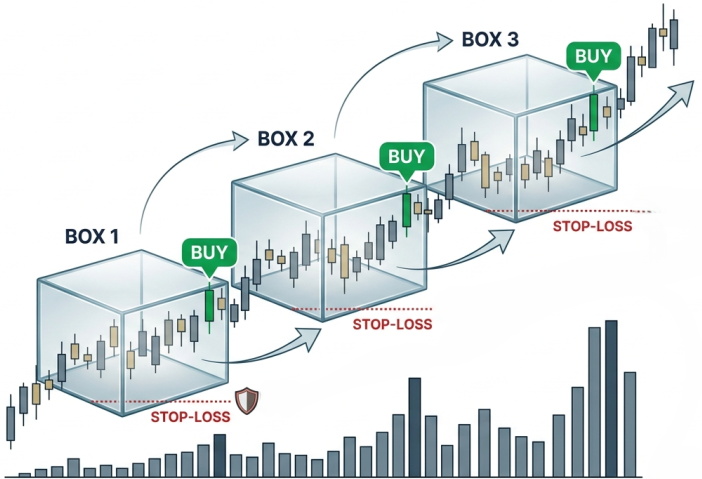
The Four Basic Steps of the Darvas Box Method
1. Identify a Strong Stock
Darvas was interested in stocks demonstrating significant strength rather than stocks simply because they looked cheap.
This is an important distinction.
A stock that has fallen 50% may appear inexpensive, but a falling price does not automatically mean that the market has recognized value.
Darvas was more interested in stocks already demonstrating upward momentum.
He also paid attention to industries and companies with strong growth potential.
In other words:
Strength came before a bargain price.
2. Wait for a Consolidation
After a strong advance, the stock may stop rising temporarily.
Instead of immediately buying, Darvas waited for the price to establish a recognizable trading range.
This became the box.
The purpose of waiting was important.
He did not want to anticipate a breakout before the market confirmed it.
The box had to develop first.
3. Buy the Breakout
Once the stock moved above the upper boundary of the box, Darvas looked for a breakout.
Volume was an important part of the equation.
A price breakout accompanied by unusually strong trading activity could provide stronger evidence that market participation was increasing.
This is one reason the Darvas approach is often described as a combination of momentum investing, breakout trading, and trend following.
The strategy does not attempt to buy a stock simply because it is undervalued.
Instead, it attempts to participate when the market demonstrates strength.
4. Protect Capital With a Stop
A breakout can fail.
That is why risk management is central to the strategy.
Darvas used stop-loss orders to limit losses when a trade moved against him.
This was especially important because he was frequently away from the market physically.
His system therefore had to work even when he could not constantly watch prices.
The broader lesson is timeless:
A trading strategy is incomplete without a plan for being wrong.
Why Trading Volume Mattered So Much
Price alone was not enough for Darvas.
He also watched volume.
Trading volume measures how many shares are changing hands during a particular period.
Suppose a stock moves above resistance while trading activity remains extremely weak.
That breakout may lack conviction.
But if the stock breaks through resistance while volume expands significantly, the move may indicate stronger participation.
This does not guarantee that the breakout will succeed.
It simply provides another piece of evidence.
That distinction is important because volume is confirmation, not a crystal ball.
Darvas Box Theory in Practice
| Stage | What Happens | Darvas' Response |
| Strong advance | Stock shows unusual strength | Put it on the watchlist |
| Consolidation | Price moves within a defined range | Establish the box |
| Breakout | Price moves above the upper boundary | Consider entering |
| Failed breakout | Price reverses and loses strength | Exit according to the risk rule |
| New advance | Stock moves into a higher range | Raise the protective level |
| New box | Another consolidation develops | Repeat the process |
The process creates a structured cycle:
Strength → Consolidation → Breakout → Risk Control → New High → New Box
That is the essence of the Darvas approach.
The Philosophy Behind the Strategy
The Darvas Box is more than a chart pattern.
It reflects a particular way of thinking about markets.
1. Follow the Market Instead of Predicting It
Darvas did not need to know exactly why a stock was going to rise.
He wanted the price action to demonstrate that buyers were already willing to pay increasingly higher prices.
This is one of the defining characteristics of trend-following strategies.
Rather than asking:
"Where should this stock go?"
the trader asks:
"What is the market telling me right now?"
2. Cut Losses Quickly
A losing position becomes dangerous when an investor starts defending it emotionally.
Darvas' approach was different.
If the market invalidated the trade, the position had to be closed.
The goal was not to avoid every losing trade.
That is impossible.
The goal was to ensure that one bad trade did not destroy the portfolio.
3. Let Winners Develop
The opposite principle applies to profitable positions.
A strong stock can continue rising far longer than an investor expects.
Selling too early can therefore be just as damaging to a trend-following strategy as holding a losing position for too long.
Darvas attempted to remain with successful trends while using protective stops to control downside risk.
This creates the classic trend-following asymmetry:
Small losses + potentially large gains.
4. Stay Out When the Setup Is Not There
One of the most underrated elements of the Darvas philosophy is patience.
There is no requirement to trade every day.
If a convincing setup does not exist, doing nothing can be the correct decision.
This principle has become even more relevant in the modern market, where investors have access to an overwhelming amount of information every minute.
More information does not necessarily produce better decisions.
Sometimes it simply creates more opportunities to make unnecessary trades.
Darvas Was Not Simply a Technical Analyst
It would be misleading to describe Darvas as someone who looked only at charts.
His approach also incorporated an interest in growth industries and companies showing strong fundamental potential.
He was particularly attracted to sectors that appeared capable of benefiting from major technological and economic changes of his era.
This creates an interesting combination:
Fundamentals helped identify what might be worth watching.
Price and volume helped determine when to act.
That distinction remains useful today.
An investor can believe that a company has excellent long-term prospects and still be wrong about the timing of a purchase.
Darvas' approach separated those two questions.
Darvas Box Theory vs. Modern Momentum Trading
Modern investors may recognize several familiar ideas in Darvas' strategy.
| Darvas Concept | Modern Interpretation |
| Strong stocks | Relative strength |
| Break above a box | Breakout trading |
| Rising volume | Volume confirmation |
| Following an upward trend | Momentum / trend following |
| Stop-loss | Systematic risk management |
| Moving the stop higher | Trailing stop |
| Avoiding weak stocks | Strength-based stock selection |
This does not mean modern trading systems are simply copies of Darvas.
Markets, technology, liquidity, and trading costs have changed dramatically.
But the underlying principle remains recognizable:
Buy strength, control risk, and allow successful trends room to develop.
The $2 Million Question
There is an important historical caveat surrounding Darvas' famous $2 million claim.
His 1960 book was titled How I Made $2,000,000 in the Stock Market, and the figure became central to his public image.
However, the size of his reported profits was later questioned.
In December 1960, TIME reported a dispute involving the New York authorities and Darvas concerning the amount of profit he had actually made. The authorities reportedly identified approximately $216,000 in profits, while Darvas argued that they had not accounted for all of his brokerage accounts.
This historical controversy is worth mentioning because it prevents the Darvas story from becoming a simple "dancer turned millionaire" legend.
The more defensible lesson is not the exact dollar figure.
It is the investment process Darvas described and the influence that process had on later trend-following approaches.
What Modern Investors Can Learn From Nicolas Darvas
Darvas lived in an era when accessing market information was difficult.
Modern investors face almost the opposite problem.
We have too much information.
Real-time charts, social media, financial news, analyst opinions, online communities, earnings releases, economic data, and algorithmic alerts are available around the clock.
That makes Darvas' emphasis on filtering information particularly relevant.
Focus on observable evidence
Opinions can change quickly.
Price and volume show what market participants are actually doing.
Define risk before entering
Do not decide where to exit only after a position starts losing money.
The exit rule should be part of the original trade plan.
Avoid confusing a cheap stock with a strong stock
A declining stock can become even cheaper.
Darvas' approach starts from the opposite premise: look for evidence of strength.
Do not force trades
No setup means no trade.
Cash can be more useful than a position that does not fit your strategy.
Let the market prove you right
Instead of trying to predict every move, wait for price action to confirm the thesis.

The Enduring Lesson of the Darvas Box
The most interesting part of Nicolas Darvas' story may not be that he was a dancer who reportedly made millions from stocks.
It may be that he developed his system precisely because he could not participate in the market like a conventional Wall Street trader.
His physical distance from Wall Street forced him to simplify.
He could not constantly react to rumors.
He could not spend every hour watching a ticker.
He had to rely on a limited set of information and predetermined rules.
That constraint helped him develop a system built around three powerful ideas:
Follow strength.
Cut losses when proven wrong.
Stay with a winning trend as long as the market continues to support it.
The Darvas Box itself is simply a framework for implementing those ideas.
Markets have changed enormously since the 1950s. Investors now have instant access to information that Darvas could only receive by telegram.
But human psychology has not changed nearly as much.
Investors still chase rising prices, hold losing positions too long, sell winners too early, and become overwhelmed by information.
That is why the story of Nicolas Darvas remains relevant.
His greatest contribution may not have been the box.
It was the idea that a trading system should tell you not only when to enter, but also when to admit that you are wrong.
Recommended Reading
Nicolas Darvas — How I Made $2,000,000 in the Stock Market (1960)
Darvas' book remains the primary source for understanding his own account of his investing journey and the development of his trading philosophy.
For modern readers, it is best approached not as a guaranteed formula for making money, but as a historical account of an early momentum and trend-following approach.
Disclaimer: The Darvas Box Theory is a historical trading methodology, not a guarantee of investment returns. Breakout strategies can produce repeated losses during choppy or range-bound markets. Investors should consider position sizing, transaction costs, liquidity, taxes, and their own risk tolerance before applying any trading strategy.


