A hedge fund that averages 66% a year, before fees, for roughly 30 years straight. If that number sounds too extreme to be real, you're not alone — even Warren Buffett's long-term average sits closer to 20%.
That fund was Medallion, run by Renaissance Technologies, the firm founded by mathematician-turned-investor Jim Simons. Unlike most legendary investors, Simons never built his edge on reading balance sheets or predicting the economy. He built it on math.
Here's what actually happened inside Renaissance, why Medallion's model can't simply be copied, and what individual investors can realistically take away from his story.

From Cold War Codebreaker to Wall Street Outsider
Simons wasn't a finance guy who picked up math on the side. It was the other way around.
Born in 1938 in Massachusetts, he earned a bachelor's degree in mathematics from MIT in 1958 and a PhD from UC Berkeley by age 23. He went on to teach at MIT and Harvard, and later worked as a codebreaker for a defense research institute connected to the NSA.
His academic reputation wasn't a footnote, either. Simons made significant contributions to differential geometry, and the Chern-Simons theory he co-developed is still used today in fields like string theory and condensed matter physics. In 1976, he won the American Mathematical Society's Oswald Veblen Prize in Geometry — one of the field's top honors.
So when Simons left academia for finance in 1978, at age 40, he wasn't starting from zero. He was starting with a research mindset that Wall Street simply didn't have yet.
What Made Renaissance Technologies Different
Simons' first company, Monemetrics, became Renaissance Technologies in 1982. The early years were rough — there was no instant formula for beating the market. But the question driving the firm was clear from the start: could data find patterns in the market that human judgment couldn't?
That question became the foundation of what's now called quantitative investing, or "quant" investing for short.
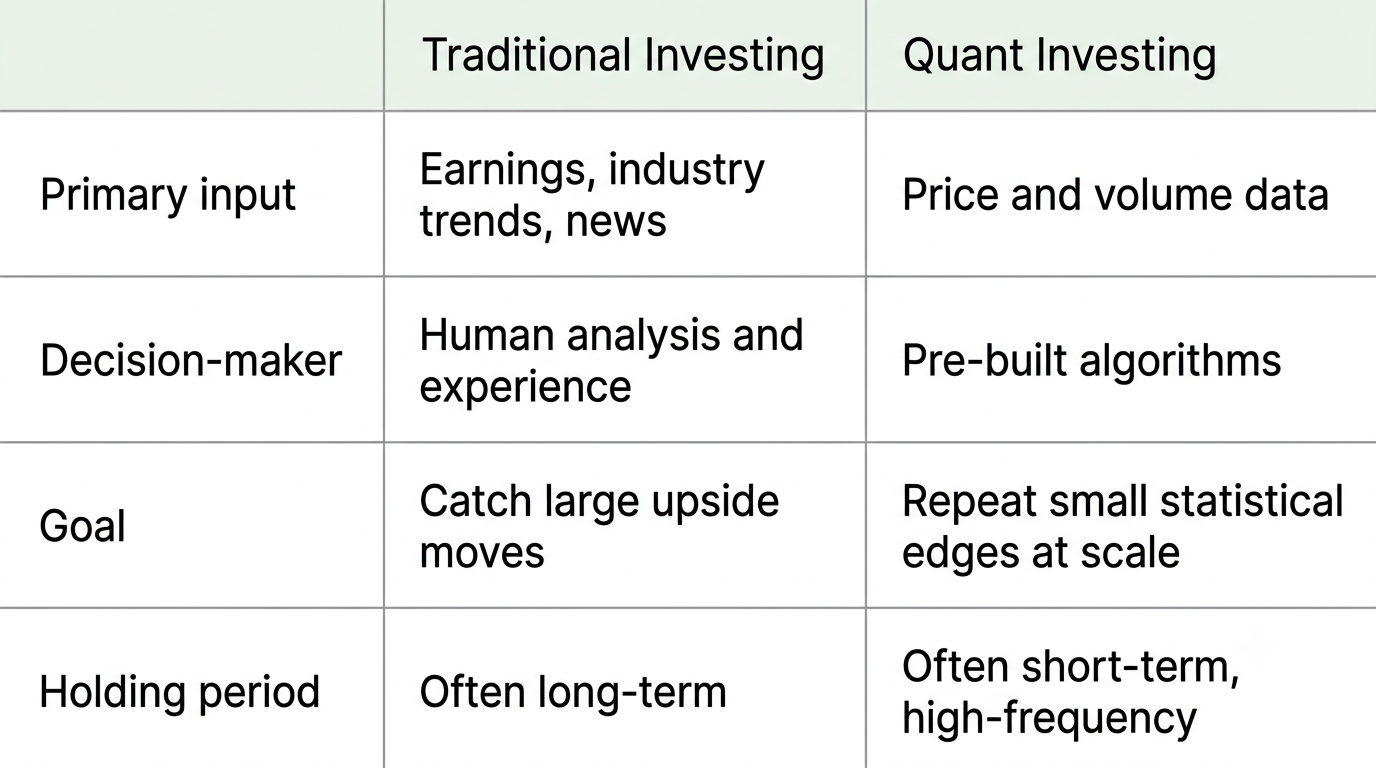
Traditional investing relies on analyzing a company's earnings, industry position, and macroeconomic conditions, then making a judgment call. Quant investing flips that order. It treats price and volume data as the primary input, and lets statistical models — not gut instinct — decide when to trade.
Renaissance's hiring philosophy reflected this shift. Instead of recruiting MBAs or Wall Street veterans, Simons went after mathematicians, physicists, statisticians, and computer scientists — people with little financial experience but a strong track record of finding structure in complex data. In effect, Simons ran a hedge fund like a research lab.

So How Did Medallion Actually Make Money?
Renaissance has never disclosed Medallion's exact trading formulas, and it's misleading to claim anyone outside the firm knows the full mechanics. What is publicly understood is that the fund leaned heavily on statistical arbitrage — exploiting small, temporary mispricings between related assets — combined with short-term, data-driven models across many markets at once.
The underlying logic isn't about predicting one big winning trade. It's closer to how a casino operates: no single hand or spin is guaranteed, but a small, consistent statistical edge compounds into a reliable outcome over thousands of repetitions.
That said, this isn't as simple as "win 51% of trades and you're rich." Real-world returns depend on transaction costs, position sizing, leverage, market liquidity, and how different strategies correlate with each other — all of which Renaissance's scientists spent decades fine-tuning.
From 1988 through roughly 2018, Medallion is widely reported to have averaged about 66% annually before fees, and around 39% after fees — figures that come from Gregory Zuckerman's book The Man Who Solved the Market and have been repeated across financial media since.
The 2008 Test
Medallion's most cited proof point is 2008. While global markets collapsed and most hedge funds posted steep losses, Medallion reportedly returned around 82% that year.
The explanation isn't that Renaissance predicted the crash. It's that extreme volatility exposes price relationships and trading patterns that don't normally appear in calmer markets — and a system built to detect and react to pattern shifts, rather than hold a fixed directional bet, was positioned to benefit from that chaos rather than get crushed by it.

Why You Could Never Actually Invest in Medallion
Here's something that surprises a lot of people: Renaissance stopped accepting new outside money in 1993, and by 2005, Medallion had become essentially closed to anyone outside the firm's employees and their families.
This wasn't exclusivity for its own sake. It came down to capacity. Strategies built around small, fleeting price discrepancies only work at a certain scale — pour in too much capital, and your own trades start moving the price you're trying to exploit. Think of it like a small boat versus a large tanker in the same narrow channel: the bigger the vessel, the more it disrupts the water around it. Medallion's edge depended on staying small relative to the opportunities it was chasing, which is precisely why it was never opened to the public.
Be Skeptical of Anyone Selling "Simons' Strategy"
While researching this piece, it's hard to miss how often Medallion's 66% figure gets used to market retail trading bots, expert advisors, and "AI-powered" automated systems — often with claims like "based on Jim Simons' methodology."
Treat these claims with real skepticism. Medallion's results came from decades of proprietary data, a concentrated team of elite scientists, and — critically — a capital base kept deliberately small enough to preserve its edge. A retail product sold to thousands of buyers can't replicate that last part by definition; if a strategy actually worked at 66% annually, opening it up to mass retail capital would erode the very edge it's selling. The more a product borrows a famous name to sell certainty, the more scrutiny it deserves.
What Individual Investors Can Actually Learn From This
The real lesson from Simons isn't "learn to code and you'll get rich." It's a set of habits that scale down just fine to an individual portfolio:
- Treat your own gut calls as hypotheses, not conclusions — write down why you're making a trade before you make it, and review it later
- Don't marry a single strategy; update your approach as new information comes in, rather than assuming your original thesis was permanently correct
- Favor repeatable, evidence-based rules over one-off intuition, especially when emotions are running high
- Be more suspicious, not less, of any product promising extraordinary and consistent returns — ask what structural advantage would make that possible, and whether it could survive being sold to the public
Medallion's success wasn't one brilliant formula. It was the result of building hypotheses, testing them against data, discarding what didn't hold up, and repeating that cycle relentlessly for decades.
The Bottom Line
Jim Simons passed away on May 10, 2024, at age 86. He described his life as having three phases: mathematician, investor, and philanthropist. Along with his wife Marilyn, he co-founded the Simons Foundation in 1994, which has funded research in mathematics, basic science, and autism for three decades.
His real legacy on Wall Street probably isn't a specific trading formula — it's the idea that even messy, chaotic markets contain patterns worth searching for, and that those patterns are only useful if you keep testing them without emotional attachment.
This article is for informational purposes only and isn't investment advice. Medallion's returns are historical and not something any retail product can guarantee to replicate. Always do your own research before making investment decisions.


