
The Question Most People Ask About Him Is the Wrong One
Ask most traders what made Bill Lipschutz one of the greatest foreign exchange traders in Wall Street history, and you'll usually get the same answer: he called the market right more often than anyone else.
That's the wrong way to look at it.
Lipschutz's own account of his career, most famously detailed in Jack Schwager's book The New Market Wizards, tells a different story. His edge wasn't forecasting accuracy. It was a set of risk rules that assumed he would be wrong on a regular basis, and still let him come out ahead over time.
So instead of asking "how did he predict currency moves so well," the more useful question is: how did he structure his trades so that being wrong didn't wipe him out?
From Architecture Student to Salomon Brothers' Top FX Trader
Lipschutz didn't set out to become a trader. He studied architectural design as an undergraduate at Cornell University before completing a finance-focused MBA at the same school.
His first real exposure to markets came almost by accident. While still a student, he inherited a modest stock portfolio and, in working out how to manage it, developed a genuine curiosity about how markets actually behaved. That curiosity, not a grand career plan, is what pulled him toward trading.
After finishing his MBA in 1982, Lipschutz joined Salomon Brothers as one of the founding members of its newly formed foreign exchange department. By 1984, he was the primary trader running the firm's proprietary FX book. He went on to head the Global Foreign Exchange Options Group and the New York trading desk in 1988, then became Global Head of Foreign Exchange the following year. After leaving Salomon Brothers, he moved into independent currency management and now leads portfolio management at Hathersage Capital Management.
What's easy to miss is how much his architecture background actually mattered. Architecture forces you to think about a structure and its individual parts at the same time — how one decision changes the load on everything else. Lipschutz applied the same lens to trading: he never looked at a single data point in isolation. Interest rates, central bank policy, market positioning, liquidity conditions, and option structures all had to be read together.

His Version of "Risk Management" Isn't a Stop-Loss
Most retail traders think of risk management as a single rule: cut the position if it drops a certain percentage. That's a reasonable starting point, but it's not what set Lipschutz apart.
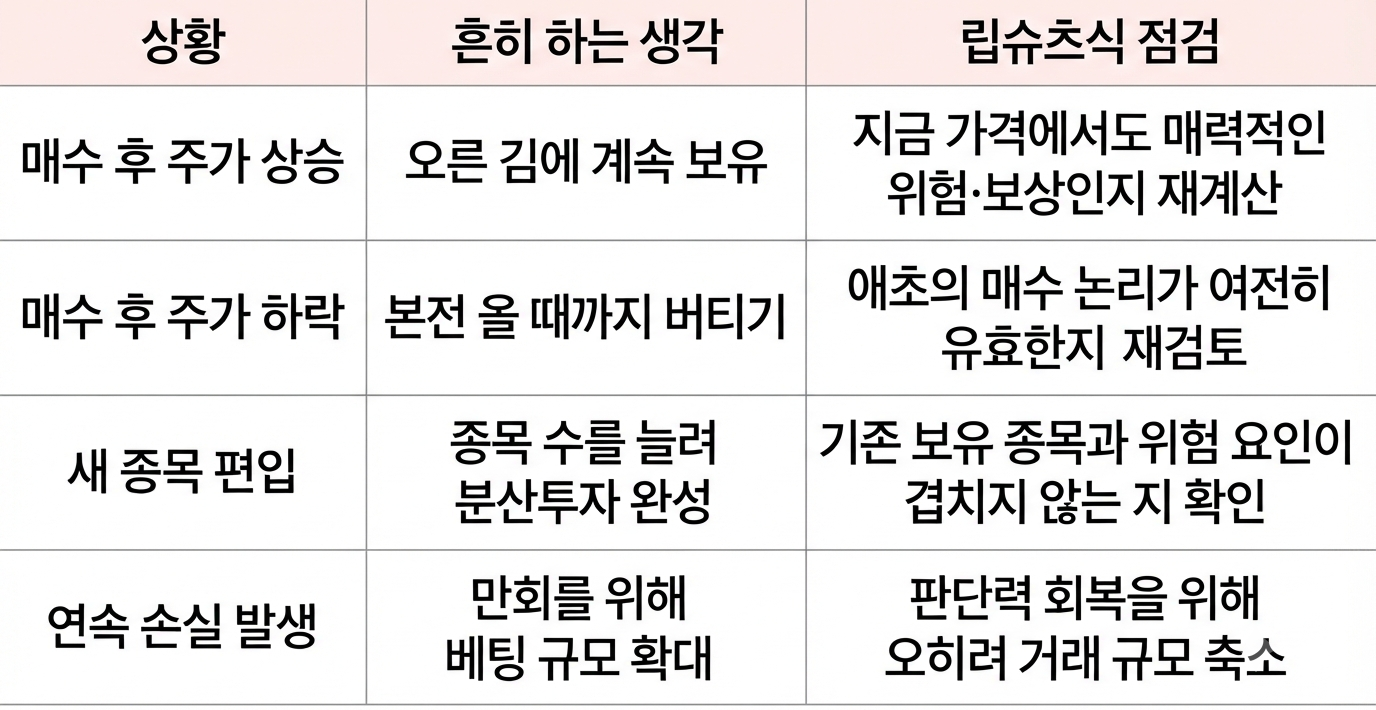
His actual framework was to separate the risk he took on when he opened a position from the risk that position carried right now. Markets move, and once they do, the original trade you entered often no longer exists in the same form — even if you're still holding the same ticker.
The practical question isn't "why did I buy this in the first place." It's: "If I were looking at this position for the first time today, at today's price, would I still want it?"
Ten Positions Isn't the Same Thing as Diversification
One of Lipschutz's core principles was avoiding concentration in trades that were highly correlated with each other, even if they looked like separate positions on paper.
This idea translates directly to a retail stock portfolio. Say an investor holds ten different semiconductor stocks, split across chipmakers and equipment suppliers. On the surface, that looks diversified — ten tickers, multiple sub-sectors. In practice, all ten are exposed to the same underlying risk: the health of the semiconductor cycle. If that cycle turns, all ten can move together.
Real diversification isn't measured by the number of positions. It's measured by whether those positions respond to different, unrelated risk factors. If your holdings all react to the same interest rate decision, the same earnings season, or the same sector headline, you don't have ten trades — you have one trade wearing ten different names.
Why He Cut Position Size After a Losing Streak
One of the more counterintuitive lessons from Lipschutz's interviews involves what he did after a string of losses.
He observed that consecutive losses don't just shrink a trading account — they distort judgment. Confidence erodes, and that erosion affects how new information gets processed and interpreted. His response was to deliberately reduce position size during rough stretches, using the smaller trades to rebuild confidence and judgment before scaling back up.
Most traders do the opposite. After a losing streak, the instinct is to "make it back" with a bigger bet. That instinct treats the losing streak as a capital problem, when it's often a decision-making problem as well. Trading larger while your judgment is compromised tends to compound the original mistake rather than fix it.
What the 1987 Yen Options Trade Actually Teaches
One trade frequently cited from Lipschutz's career is a large Japanese yen options position from 1987, structured as a bull call spread — buying calls at one strike while simultaneously selling calls at a higher strike. The notional size of the position, if it moved into the money, ran into the hundreds of millions of dollars.
The headline number isn't the interesting part. What matters is the structure: by selling the higher-strike calls against the ones he bought, Lipschutz built a position with a defined cost and a defined payout range, rather than an open-ended bet. A large notional value doesn't automatically mean a proportionally large loss potential — the structure determines that, not the size alone.
For retail investors using options or leveraged products, the takeaway is straightforward: understand the structure of a position before focusing on how much exposure it represents.

A Practical Checklist Based on His Approach
- Calculate the downside before the upside. Before entering a trade, write down what you lose if you're wrong — not just what you stand to gain if you're right.
- Re-evaluate positions at today's price, not your entry price. A good reason to buy six months ago isn't automatically a good reason to hold today.
- Map correlated risk across your portfolio. Group holdings by what actually moves them — sector, interest rate sensitivity, currency exposure — not just by ticker count.
- Cut size, not conviction, after a losing streak. Reducing position size protects your decision-making while you work out what went wrong.
- Evaluate the structure of leveraged or derivative positions, not just the dollar amount at risk.
The Real Lesson: Survival, Not Prediction
Bill Lipschutz's reputation wasn't built on getting the direction of the market right more consistently than anyone else. It was built on designing trades that assumed he'd sometimes be wrong, and on cutting risk quickly when that happened rather than hoping the market would come back around.
No trader, professional or retail, can predict market direction with certainty. What's actually within your control is how much you risk on any single idea, how correlated your positions are with each other, and how you respond when a losing streak starts to affect your judgment.
That's the version of Lipschutz worth studying — not the trader who called every move, but the one who built a process to survive the moves he got wrong.
This article is for informational purposes only and does not constitute investment advice. Leveraged and derivative products carry a high risk of loss and are not suitable for every investor.


