Most beginner forex traders ask one question: "Will the price go up or down?" Veteran traders ask a second one, right alongside it: "Which way has everyone else already leaned?"
That second question is the core of how Imai Masashi, a well-known Japanese FX analyst, reads currency markets. His background is unusual for a trader — decades on a bank dealing desk, a stint running his own trading firm, and even a term as a member of Japan's House of Representatives. That mix of trading-floor experience and policy exposure shapes a way of reading the market that goes beyond staring at candlesticks.
This article breaks down his core idea — "positioning crowding" — and turns it into a checklist retail traders can actually use, without needing to track Japanese-language sources or attend his seminars.

Who Is Imai Masashi?
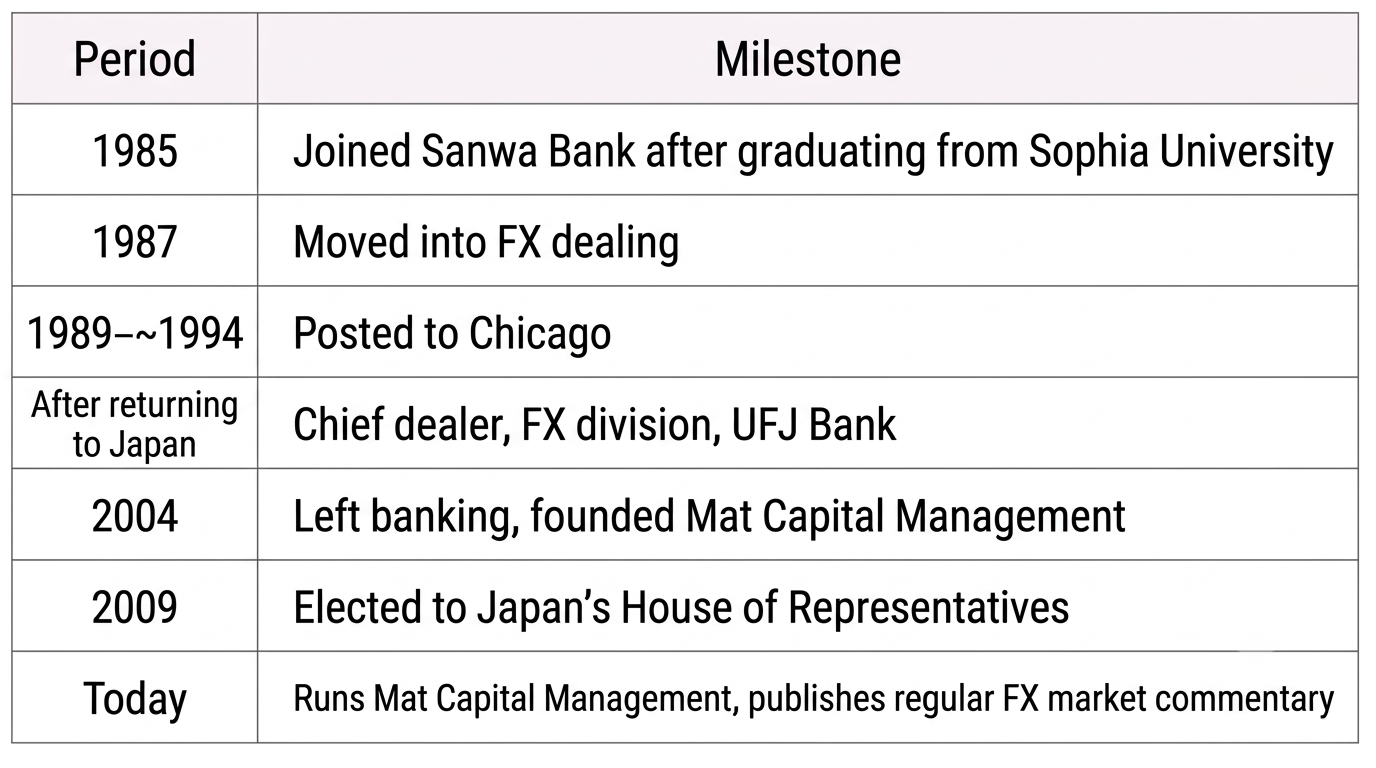
What makes his perspective interesting isn't the resume line items on their own — it's the combination. A dealer sees order flow up close. An analyst has to explain that flow to a general audience. A politician has to think about how policy decisions ripple through markets. Few commentators have sat in all three seats.
He remains active today, regularly weighing in on USD/JPY, US economic data, and Bank of Japan policy through market commentary and trading seminars.
The Core Idea: Positioning Crowding
Strip away the jargon and "positioning crowding" means something simple: too many traders are leaning the same direction at once.
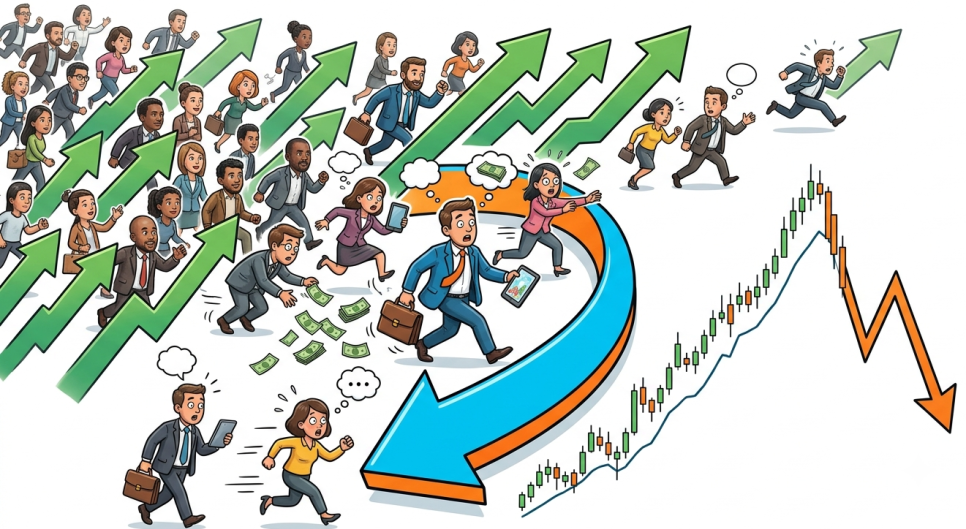
Here's why that matters. Imagine 100 traders in a market, and 90 of them are long the dollar. For a while, that's fine — as long as new buyers keep showing up, the trade keeps working.
But eventually a weaker-than-expected data release hits. A handful of traders start selling. The price dips slightly. That small dip makes other longs nervous, so they start trimming positions too. More selling pushes the price down further, which triggers even more stop-outs.
You end up with a feedback loop: weak data → light selling → price dip → nervous exits → more selling → sharper price dip.
The lesson isn't that crowded trades are dangerous in themselves. It's that a crowded trade has less room to absorb bad news than a balanced one does. When one side of the market is packed with the same position, a small shock can produce an outsized move — simply because there's a long line of traders ready to sell (or buy) at roughly the same trigger point.
Why "Everyone Is Long" Doesn't Mean "Sell Now"
This is where a lot of retail traders get the concept backwards. Seeing that a trade is crowded and immediately fading it — betting against the crowd purely because the crowd is big — is a common mistake.
Crowded positioning can persist for a long time in a strong trend. If fresh buying keeps entering a rally, the "everyone is already long" fact alone won't stop the price from climbing further. Traders who short a strong uptrend just because sentiment "feels stretched" often end up covering at a loss.
So what should you actually watch for? Not the crowding itself, but whether something has emerged that's capable of breaking it — a surprise in a jobs report, a shift in central bank tone, an unexpected rate decision. Crowding is the setup; a catalyst is what actually triggers the unwind.
Watch the Reaction to News, Not Just the News
One detail worth borrowing from this approach: pay more attention to how the market reacts to news than to the news itself.
A couple of examples make this concrete:
- Good economic data comes out, but the dollar barely moves. That's often a sign the market had already priced it in — or that opposing selling pressure is stronger than it looks.
- Bad data comes out, but the dollar doesn't fall. That can signal underlying demand for dollars is more resilient than the headline suggests.
In both cases, the surprise isn't in the data — it's in the muted or absent reaction. That gap between "what the news should have done" and "what the price actually did" is often more informative than the news itself.
A Practical Checklist for Retail Traders
Turning this into something usable doesn't require institutional-level data. A simple sequence works:
- Direction check — Which way does current sentiment appear to lean? (Retail sentiment trackers, COT reports, or even social media chatter can give a rough read.)
- Sustainability check — Is fresh capital still flowing into that trade, or does momentum look like it's fading?
- Catalyst check — Is there a scheduled event (central bank meeting, jobs report, inflation print) that could challenge the current lean?
- Reaction check — After the catalyst hits, did the price move the way the crowd expected — or the opposite way?
- No-trade option — If the answers above are unclear, sitting out is a legitimate decision, not a missed opportunity.
That last point is the hardest one to follow in practice. Not trading feels like losing out, especially when a chart looks "obviously" set up for a move. But forcing trades during unclear conditions is a common way small accounts bleed out through overtrading, not through any single bad call.

Does This Apply to Chart-Only or Candlestick Traders?
Even traders who deliberately ignore news and trade purely off price action can use this framework indirectly. A sudden expansion in candle range, or a long wick rejecting a level, is frequently the visible footprint of a crowded position unwinding in real time. You don't need to track the news catalyst to benefit from the concept — the crowding shows up in price behavior itself, even if you never look at an economic calendar.
Key Takeaways
- Price alone doesn't tell the full story — who's positioned which way, and how firmly, matters just as much.
- A crowded trade isn't automatically a reversal signal. Strong trends can stay crowded for a long time.
- Look for a real catalyst capable of breaking the current lean before betting against it.
- Compare the market's actual reaction to news against what that reaction "should" have been.
- When the signals are mixed, staying flat is a valid strategy, not a failure to act.
Forex trading involves leverage, and losses can exceed what a simple price move might suggest. This article summarizes a way of interpreting market behavior for educational purposes — it isn't investment advice, and any real trading decision should include proper risk management suited to your own account and risk tolerance.


