Most investors dread a market crash. Mark Spitznagel has spent his entire career preparing for one. As the founder of Universa Investments and one of the pioneers of "tail risk hedging," he built a strategy specifically designed to turn a market collapse into an opportunity rather than a catastrophe.
This article breaks down who Spitznagel is, how tail hedging actually works, what happened when his fund posted a jaw-dropping return during the 2020 crash, and — more importantly — what ordinary investors can realistically take from his approach without trying to replicate a hedge fund's options book.

Who Is Mark Spitznagel?
Spitznagel's path into finance started early. At just 16, he was working the trading floor of the Chicago Board of Trade, where he was mentored by Nassim Nicholas Taleb — the economist who later popularized the term "black swan." The two would go on to run a tail-hedging fund together, Empirica Capital, before going their separate ways.
Academically, Spitznagel holds an undergraduate degree from Kalamazoo College and a graduate degree in mathematics from the Courant Institute of Mathematical Sciences at New York University. That combination — hands-on trading experience paired with rigorous quantitative training — shows up directly in how he designs his hedges.
In 2007, after running the options desk at Morgan Stanley, Spitznagel launched Universa Investments in Miami. The firm has since become one of the best-known names in tail-risk management, advised by Taleb as its scientific adviser.
One detail that surprises people who look him up: Spitznagel also owns and runs Idyll Farms, a goat dairy in northern Michigan that makes French-style artisan cheese. He's spoken publicly about seeing the same underlying pattern in both businesses — systems that look stable in the short run can build up hidden fragility that eventually breaks all at once, whether that's a monetary system or a monoculture farm.
What Tail Risk Hedging Actually Means
In statistics, a "tail event" is something that sits at the extreme edge of a probability distribution — rare, but capable of causing outsized damage when it happens. In markets, that means a crash, not a routine pullback.
Tail hedging is the practice of paying a small, steady cost to protect a portfolio against exactly that kind of rare, extreme event. In practice, Universa does this mainly by buying deep out-of-the-money put options — contracts that only pay off if the market falls far below its current level.
Here's the mechanism in plain terms:
- A put option gives its holder the right to sell an asset at a set price, regardless of how far the market drops below it.
- A deep out-of-the-money put — say, one struck 30% or 40% below the current index level — is cheap in calm markets because the odds of it ever being worth exercising seem low.
- When a real crash hits, that same option's value can spike dramatically, because the gap between the strike price and the falling market price widens fast.
Think of it the way most people think about insurance. You pay a premium every year whether or not your house burns down. Tail hedging works the same way — except when the "fire" does happen, the payout isn't just used to cover the loss. It becomes fresh capital to buy assets while everyone else is selling.
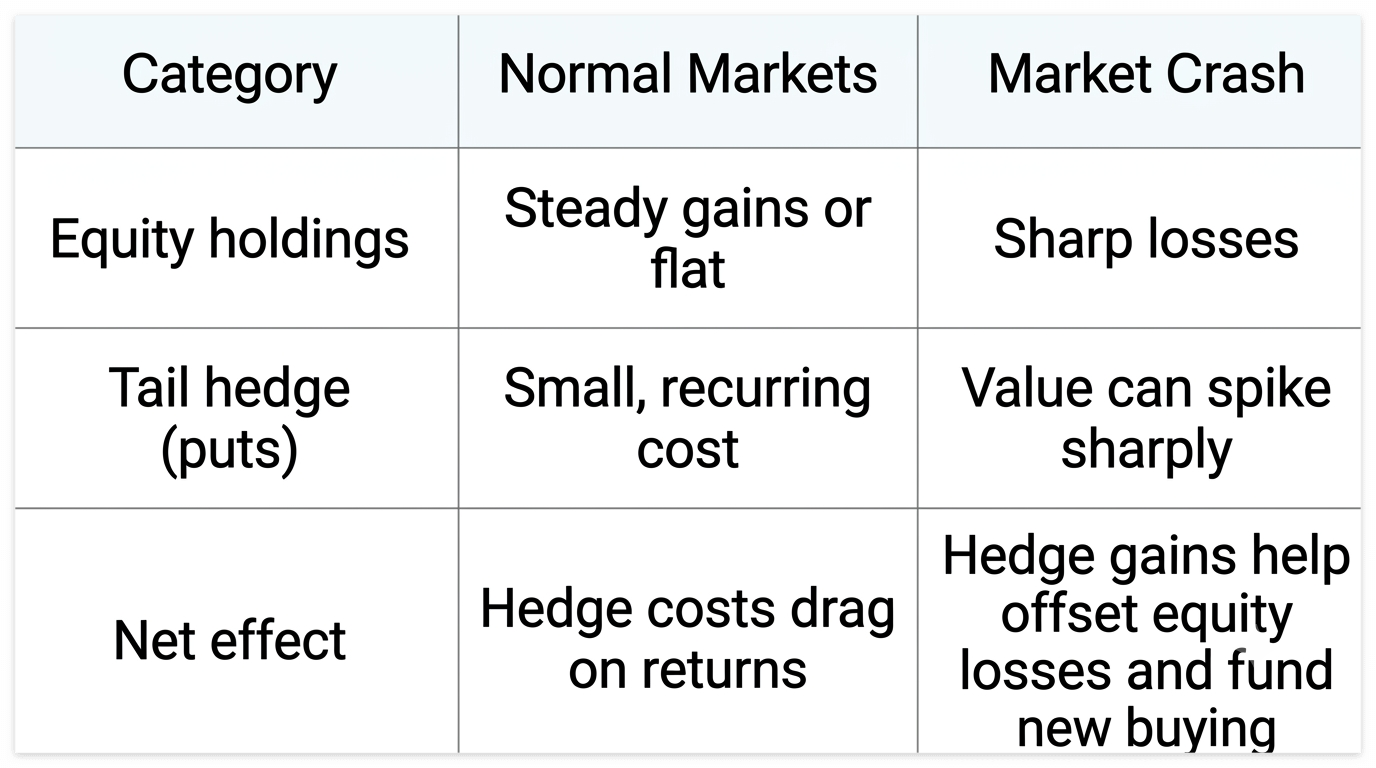
Spitznagel often summarizes his philosophy as accepting "many small losses in exchange for one enormous payoff." That's not a literal count — it's shorthand for a strategy built around a lopsided payoff profile: modest, recurring costs most of the time, in exchange for a large, asymmetric gain in rare crash scenarios.
The 2020 Crash: What the Headline Number Actually Means
When COVID-19 triggered a global market sell-off in the first quarter of 2020, Universa's tail-hedging strategy reportedly returned somewhere in the range of 3,600% to over 4,000% on the capital allocated to that specific hedge, according to financial media coverage at the time.
That number tends to get misread. It does not mean Universa's total assets under management grew by 40 times — it refers to the return generated by the relatively small slice of the portfolio dedicated to the hedge itself. Typically, only a few percent of a portfolio's total capital sits in the tail hedge; the rest stays invested in growth assets like equities.
The real story is what that small position did for the whole portfolio: a large gain on a small allocation was enough to meaningfully cushion the losses from the much larger equity allocation during the crash. That's the entire point of the design — not to bet the farm on a crash, but to make sure a crash doesn't wipe out the farm.
Why Avoiding Big Losses Matters More Than Chasing Big Gains
There's a math problem at the heart of Spitznagel's philosophy, and it's one every investor runs into eventually: losses and the gains needed to recover from them aren't symmetric.
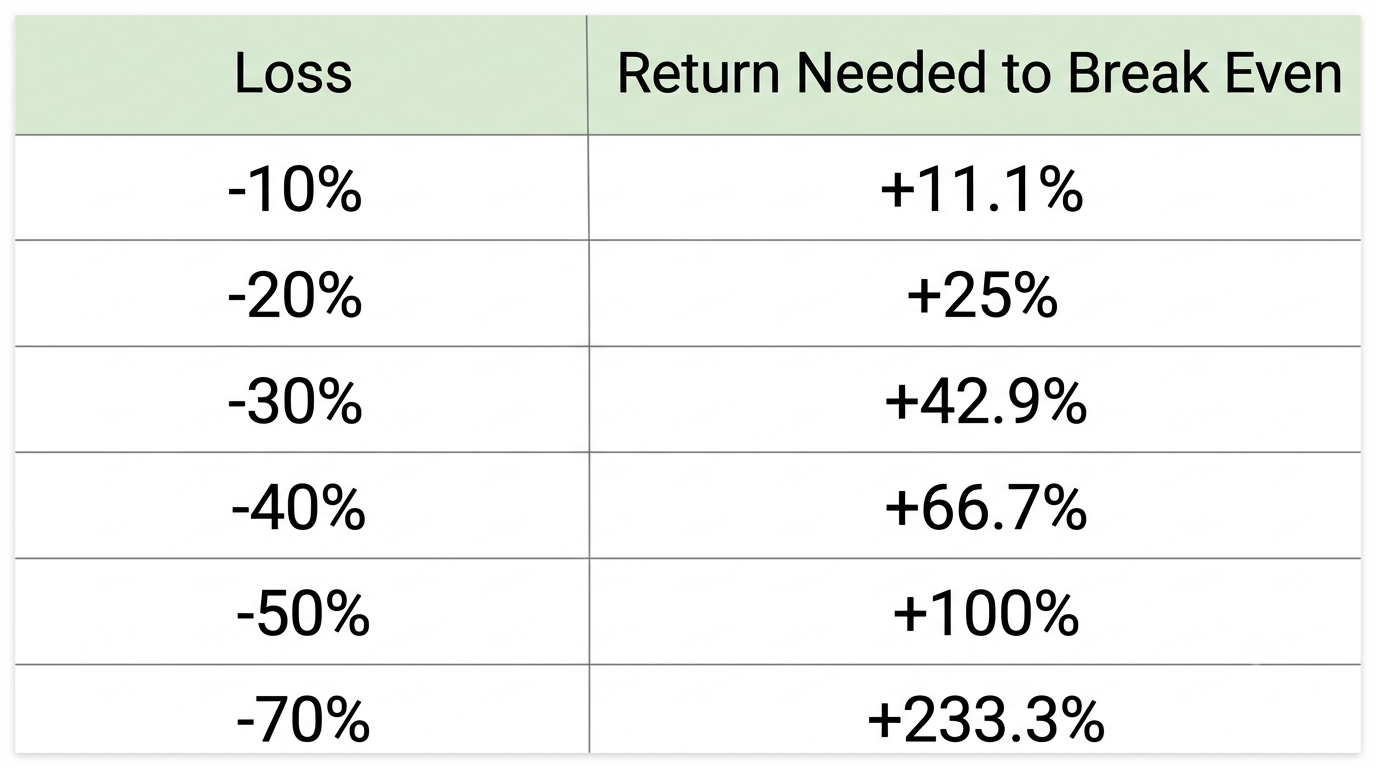
A 50% drawdown doesn't need a 50% recovery — it needs a full doubling. That asymmetry is why avoiding large losses can do more for long-term compound growth than chasing higher returns ever could. Spitznagel has built an entire investment thesis, and later a book — Safe Haven (2021) — around this single idea: protecting the downside isn't a defensive afterthought, it's a growth strategy in disguise.

How Tail Hedging Differs From Traditional Diversification
Standard portfolio theory says you reduce risk by spreading capital across uncorrelated assets — stocks, bonds, cash, maybe gold. That works well most of the time. The problem is what happens during a genuine panic.
In a systemic crisis like 2008 or March 2020, correlations across asset classes tend to spike together. Stocks fall, credit spreads blow out, and even some "safe" assets stop behaving the way investors expect. Diversification that works in calm markets can quietly fail exactly when it's needed most.
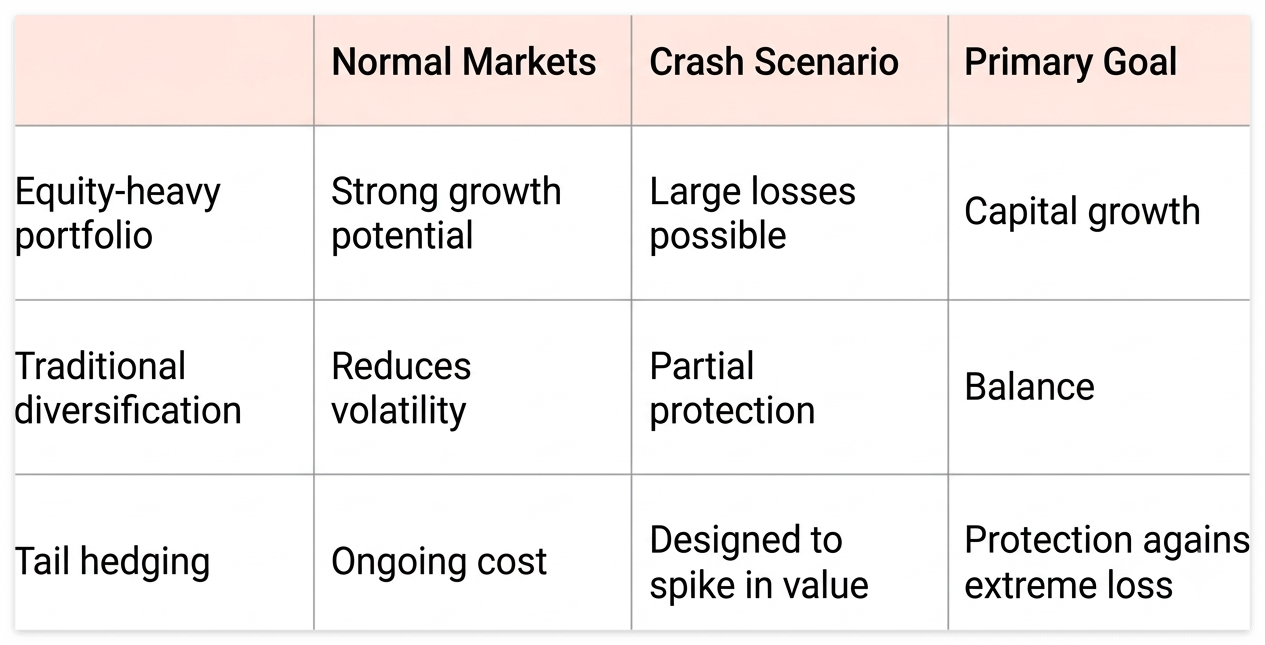
Tail hedging isn't a replacement for diversification — it's a separate layer aimed specifically at the scenario where normal diversification breaks down. That said, it isn't free or risk-free either. Hedge costs compound over time if a crash never comes, and getting the structure wrong — the wrong strike price, expiration, or position size — can mean paying for protection that doesn't actually deliver when you need it.
The Austrian Economics Behind the Strategy
Spitznagel's investment philosophy draws heavily from the Austrian School of economics, particularly the work of Ludwig von Mises and Eugen von Böhm-Bawerk. His 2013 book, The Dao of Capital, centers on a concept called "roundaboutness" — the idea that the most productive path to a goal is often not the shortest one. Sometimes it pays to accept a slower, less direct route now in order to build something far more valuable later.
Applied to investing, that translates into a willingness to absorb ongoing costs and short-term underperformance in exchange for being positioned to act decisively when a rare opportunity — a crash — actually arrives.
What Individual Investors Can Realistically Take From This
Here's the honest caveat: retail investors trying to literally copy Universa's strategy by buying cheap out-of-the-money puts every month usually don't get the same results. Institutional tail hedging involves carefully calibrated strike prices, expirations, position sizing, and liquidity management — it's specialized derivatives engineering, not a simple recurring trade. Without that precision, most individual attempts just bleed money on premiums without ever getting the payoff structure right.
That doesn't mean the underlying lessons are out of reach. A few translate well to a normal brokerage account:
- Treat avoiding large drawdowns as a return strategy, not just risk management. Rebalancing rules or predefined trimming triggers can reduce the odds of a 40-50% portfolio loss, which does more for long-term compounding than most people assume.
- Decide your crash-response plan before the crash happens. Investors who panic-sell during a drawdown tend to lock in losses; having predetermined buy levels or a rebalancing schedule removes emotion from the decision when it matters most.
- View cash reserves as a strategic asset, not idle money. Keeping some dry powder available specifically for downturns is a simpler, lower-cost way to capture some of the same "buy when others are selling" advantage that tail hedging provides.
The takeaway from Spitznagel isn't "buy puts." It's a mindset: stop asking only how much a portfolio can grow, and start asking what happens to it — and to you — in the 5% of scenarios where markets fall apart.

The Bottom Line
Spitznagel's strategy follows a clear sequence: pay a small ongoing cost → market crashes → hedge pays off → redeploy that capital into cheap assets → participate in the recovery → benefit from stronger long-term compounding. The 2020 headline number gets attention, but the real value of the approach lies in that full sequence, not the single spike in returns.
The question Spitznagel's career keeps circling back to isn't whether a crash will happen — it's what an investor is actually prepared to do when it does.
This article is for informational purposes only and does not constitute investment advice or a recommendation to buy or sell any financial product. Options and derivatives trading carries significant risk of loss and requires a thorough understanding of the underlying mechanics before use.


