Every time markets get rocky, the same piece of advice resurfaces: "buy when others are fearful." It's one of the most quoted lines in investing — and few names are as closely tied to it as John Templeton.
But there's a catch most beginners miss. Templeton wasn't buying stocks simply because they'd fallen. What he actually looked for was the gap between a company's real worth and its market price. Mistake a falling price for a bargain, and you're not investing like Templeton — you're just catching a falling knife.
This guide breaks down the core principles behind Templeton's approach, along with practical questions you can ask before buying into any beaten-down stock.

Why "Cheap" and "Undervalued" Aren't the Same Thing
Imagine a stock drops from $100 to $50. On the surface, that looks like a 50% discount. But if the company's earnings, cash flow, and balance sheet have deteriorated at the same time — say its intrinsic value has actually fallen to $30 — then $50 isn't a bargain at all. It's still overpriced relative to what the business is worth today.
This is the distinction Templeton built his career on. Founded in 1954, the Templeton Growth Fund ran for nearly four decades under this philosophy before being sold to Franklin Resources in 1992. Templeton reportedly held positions for an average of about four years, and when he couldn't find stocks that met his criteria, he was willing to let cash build up to roughly half of the portfolio while he waited. That same discipline — value, patience, and bottom-up company analysis — still shapes how Franklin Templeton's global equity strategies operate today.
The takeaway: the size of a price drop tells you almost nothing on its own. The real question is whether today's price sits meaningfully below what the business is actually worth.
Not Every Sell-Off Is a Buying Opportunity
A stock can fall 30% for a dozen different reasons — and they don't all mean the same thing. Before treating a drop as an opportunity, it's worth tracing the cause.
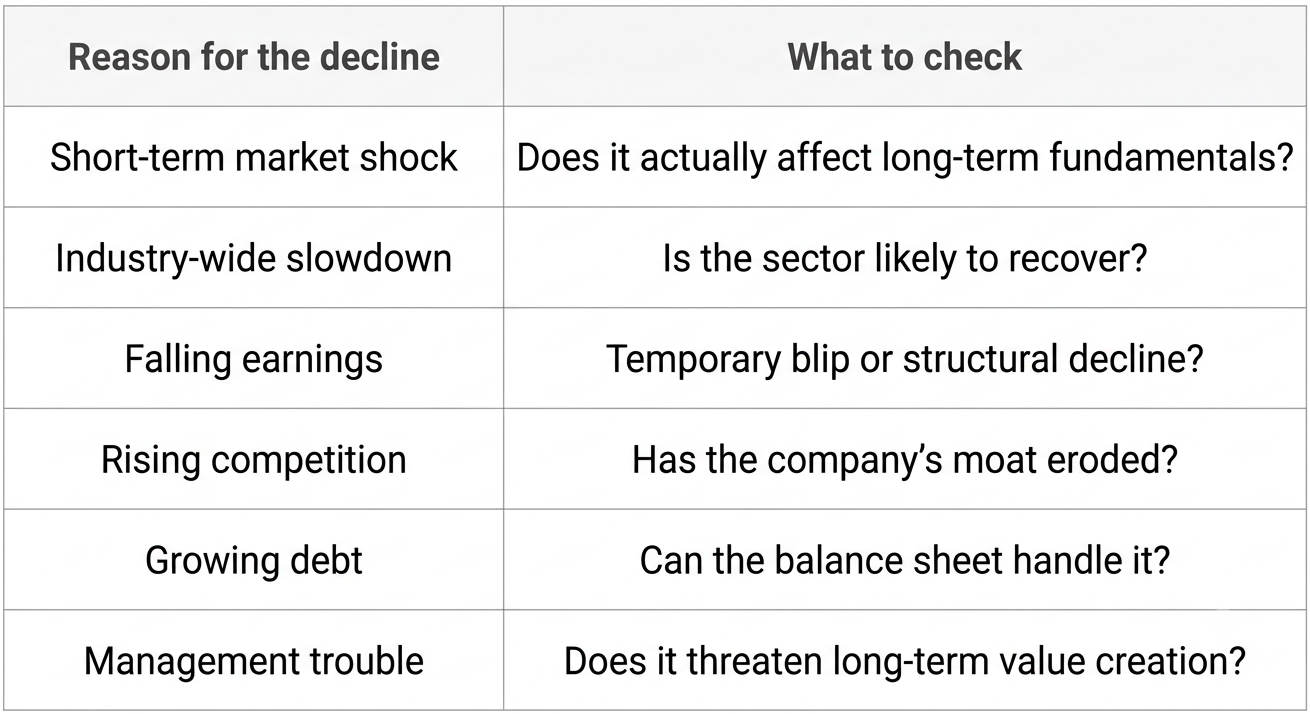
Skipping this step and buying purely because a stock "looks cheap" isn't contrarian investing — it's guesswork dressed up as strategy.
Two Kinds of Pessimism — and Why the Difference Matters
Templeton's philosophy is often summed up as "buy at the point of maximum pessimism." But blanket pessimism isn't automatically a green light.
Market pessimism generally falls into one of two categories:
- Overreaction — fear that has pushed the price well below what the fundamentals justify
- Justified concern — a genuine, ongoing deterioration in the company's prospects
If a broad market downturn hits a stock even though the underlying business still generates solid cash flow and holds its competitive position, that gap between price and value may be worth a closer look. But if a company's core products are losing ground and debt is piling up at the same time, that's not a discount — it's value being destroyed in real time. Learning to tell these apart is arguably the hardest and most important skill in contrarian investing.
Why a Low P/E Ratio Alone Doesn't Prove a Stock Is Cheap
The price-to-earnings (P/E) ratio is usually the first metric new investors reach for. It's simple: divide the share price by earnings per share to see how the market is pricing a company's profits.
The problem is that a low P/E can mean very different things. Earnings might be temporarily inflated, making the ratio look artificially low. Or a company might trade at a high P/E precisely because the market expects strong future growth, even if current profits are modest.
Instead of stopping at the P/E number, it helps to ask:
- Are these earnings sustainable, based on multiple years of history — not just the last one?
- Is the company generating real cash, or just reporting accounting profits?
- Can the business comfortably service its debt?
- Does it have a competitive advantage that rivals can't easily copy?
- Is the current setback temporary, or structural?
Avoiding the Value Trap
This is where many investors get burned. A low P/E or price-to-book (P/B) ratio doesn't automatically signal an undervalued stock — sometimes it reflects a business in genuine decline, not a market overreaction. This pattern has a name: the value trap.
If a company's revenue has been shrinking for years, its market share keeps eroding, and competitors are catching up technologically, a low valuation isn't a bargain — it's a warning sign. The key question isn't "is this cheap?" but "is the underlying business actually intact?"
Resisting the Crowd
Markets don't run on pure logic. When prices rise, investors tend to expect them to keep rising; when prices fall, fear takes over and expectations turn negative. That emotional swing is exactly what creates the gap between price and value that contrarian investors look to exploit.
But there's a nuance here too: being contrarian doesn't mean automatically betting against the crowd. The goal isn't to assume the market is wrong — it's to ask whether the market's current judgment might be wrong, and to check that against the evidence.
Patience Is the Hardest Part
Finding an undervalued stock doesn't mean the price will recover on any predictable timeline. In fact, the waiting period after the analysis is done is often the most difficult part of value investing.
As mentioned earlier, Templeton held positions for roughly four years on average, and was comfortable sitting on a large cash position when nothing met his standards. That same principle — prioritizing long-term fundamentals over short-term sentiment, and waiting for the right price rather than forcing a trade — still underpins how Templeton-style funds operate today.

Templeton vs. Graham vs. Buffett
Value investing is often associated with three names: Benjamin Graham, Warren Buffett, and John Templeton. All three share a core belief — that market price and business value can diverge — but each emphasized something different.
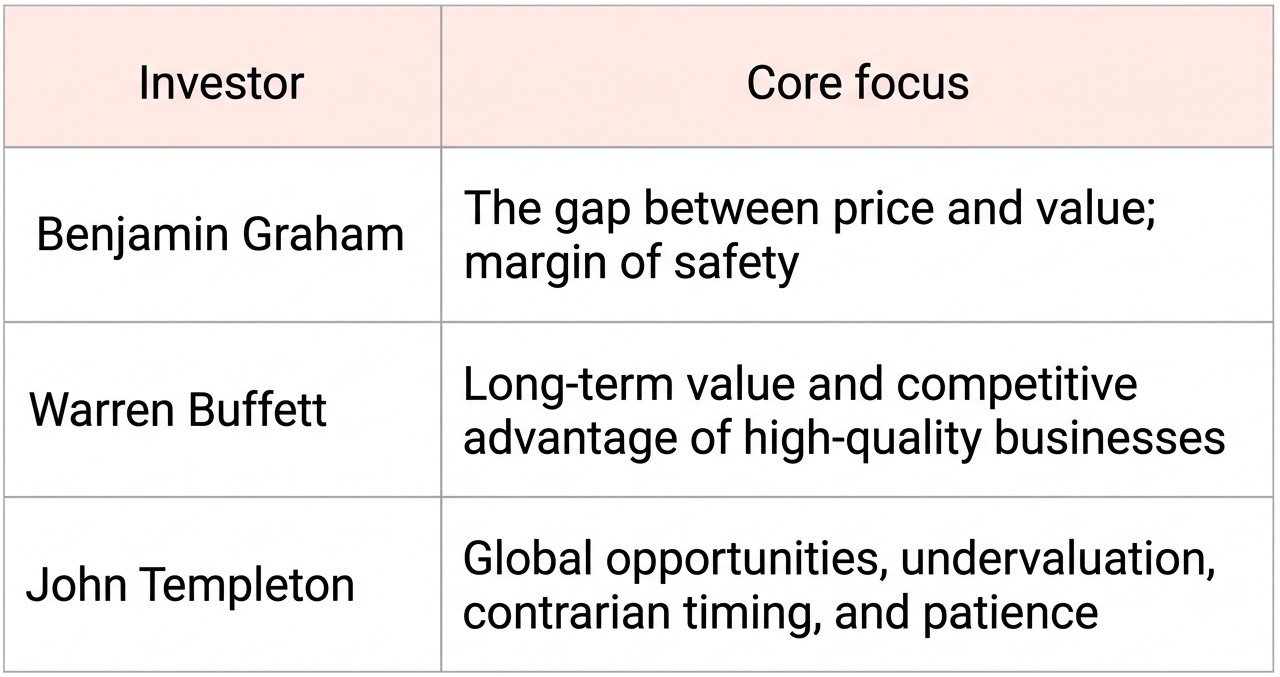
None of these can be reduced to a single idea, but all three prioritized long-term business value over short-term market noise.
A Six-Step Checklist for Evaluating a Potential Bargain
You don't need a complex model to start applying this framework. Before buying a stock that's fallen sharply, work through these questions in order:
- Why did the price drop?
- Is the company's long-term competitive position still intact?
- What do recent earnings and cash flow actually show?
- Is the debt load manageable?
- Is the current price meaningfully below the company's real value?
- If I'm wrong about this, what would be the reason?
That last question is easy to skip but arguably the most valuable. Most investors focus entirely on why a stock should go up. Asking why your own analysis might be wrong forces a more honest, less emotionally driven decision.
A Few Cautions Before You Apply This
Templeton's reputation doesn't mean every falling stock deserves a second look. If a company's underlying value really is deteriorating, the price can keep falling — sometimes for good reason.
Past success with this approach also doesn't guarantee future results. A sharp decline can reflect either market overreaction or the market catching up to a real problem, and the investor's job is to tell the difference — not to treat every crash as a buying signal.
Even careful analysis can be wrong. A stock you believe is undervalued may never recover to the level you expect, which is why spreading investments across multiple positions — rather than concentrating heavily in one — tends to be the safer approach. That said, diversification reduces risk; it doesn't eliminate the possibility of loss.

The Bottom Line
John Templeton's approach can be summed up in one idea: look past short-term market mood and focus on the gap between a company's long-term value and its current price.
A steep decline and genuine undervaluation are not the same thing, and no single ratio — P/E, P/B, or otherwise — can capture a company's true worth on its own. Being contrarian doesn't mean automatically opposing the crowd, and finding a good opportunity often means waiting until the market comes around to recognizing it. Throughout the process, managing the risk that your own judgment could be wrong is just as important as the initial analysis.
Ultimately, finding undervalued stocks isn't about spotting "cheap-looking" names. It's about patiently working through why a price is low, whether that reason is temporary or structural, and whether the company's long-term value is likely to hold up.
This article is for informational and educational purposes only and does not constitute investment advice or a recommendation to buy or sell any security. All stock market investments carry the risk of loss.
Sources
- Franklin Templeton, Templeton Global Equity Strategy overview materials
- The Templeton Touch by William Proctor (1983), referenced in Franklin Templeton track-record materials


