SPY, VOO, IVV, and SPYM all track the S&P 500, yet SPY sits at the top of almost every ETF list. To see why, it helps to know where SPY came from. This guide covers who created SPY, why it isn't quite "the first ETF," and how State Street's five best-known funds (SPY, SPYM, GLD, DIA, XLF) differ in ways that matter before you buy.

Who created SPY?
The idea is usually credited to Nathan Most, an executive at the American Stock Exchange (AMEX) who had spent his career in commodities. Steven Bloom, AMEX's vice president of product development, drove the project with him. Neither built it alone.
It started with a crash. On October 19, 1987, the Dow fell 22% in a single day. In February 1988 the SEC published its post-mortem, The October 1987 Market Break, which suggested that a tradable basket of stocks could change how program trading worked. Most, then 74, took up the challenge.
His commodities background supplied the mechanism. Grain stored in a warehouse changes hands through a warehouse receipt, so he asked Bloom why securities couldn't work the same way. That is where the name comes from: Standard & Poor's Depositary Receipts, or SPDR (pronounced "spider").
Getting from idea to product took about five years. The team included AMEX colleagues, State Street Bank, the trading specialist Spear, Leeds & Kellogg, and the law firm Orrick, Herrington & Sutcliffe, working alongside regulators.
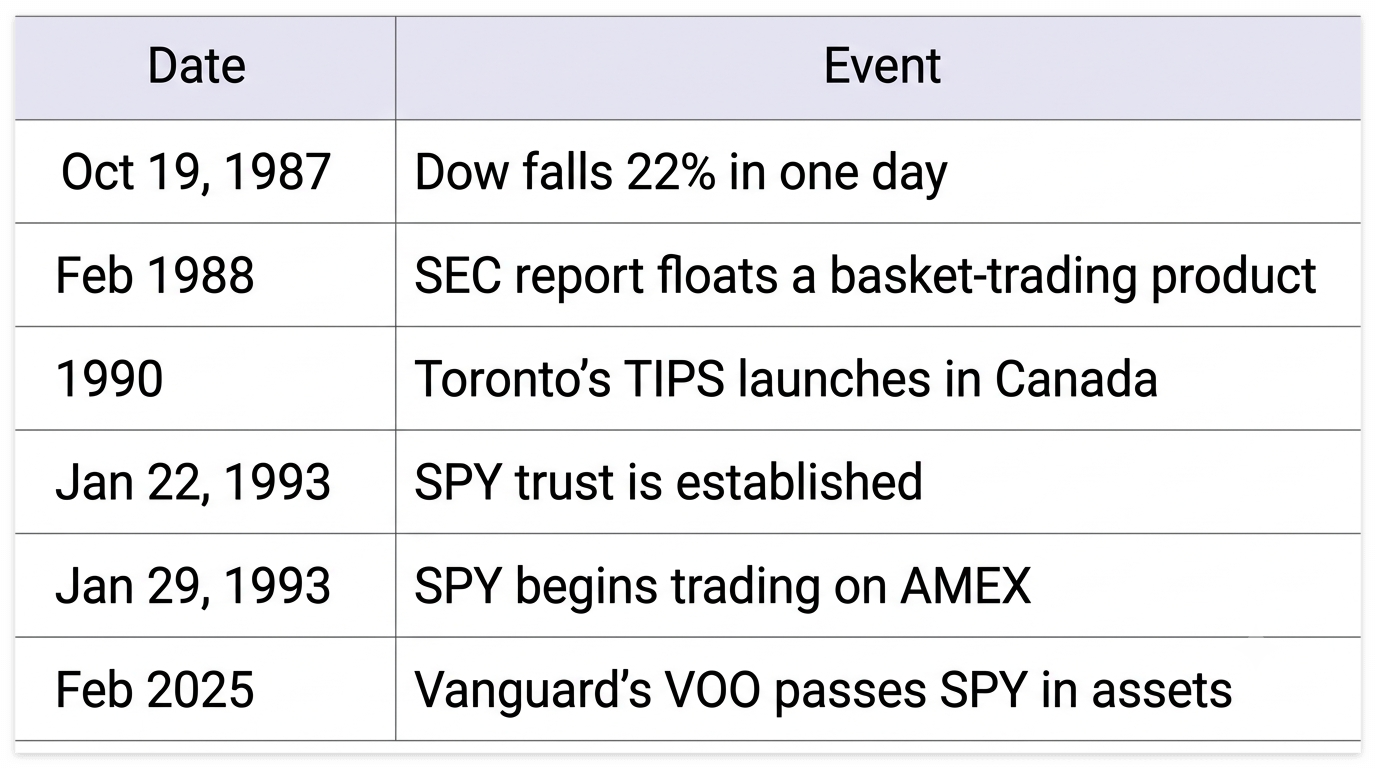
The two January dates confuse people. The 22nd is when the trust was created, and the 29th is when investors could first buy and sell shares.
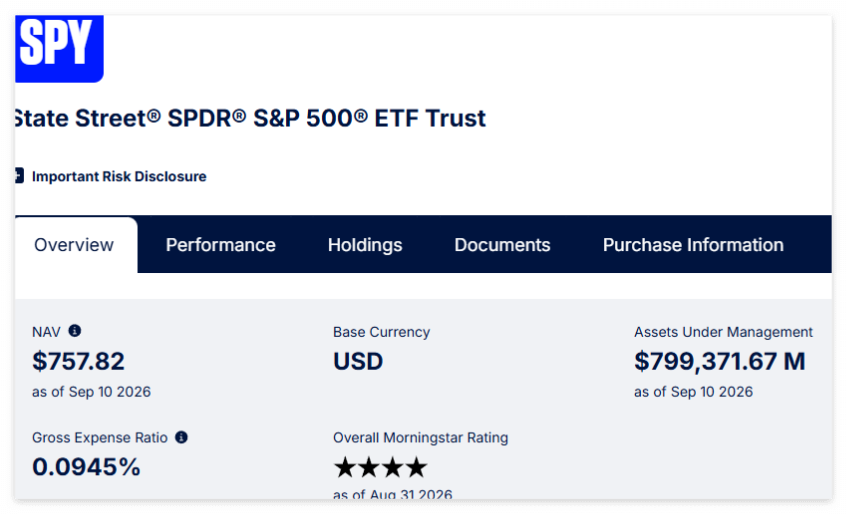
The start was modest. SPY traded about one million shares on day one, then fell to roughly 18,000 a day by mid-June, according to Bloomberg. The initial fee was 0.20%, the same as the Vanguard 500 Index Fund's at the time. Today the fee is 0.0945% and the fund holds roughly $800 billion.
Was SPY the first ETF?
It was the first ETF listed in the United States, which is the safer way to put it. Canada's TIPS launched in 1990, and index participation shares, similar basket products, had traded on AMEX and other exchanges a few years before SPY.
SPY's size lead didn't last either. VOO overtook it in February 2025 and now holds over $1 trillion, so history and scale are separate questions.
State Street's five best-known ETFs
State Street's asset management arm was renamed State Street Investment Management (formerly State Street Global Advisors) on June 30, 2025. The SPDR brand and the tickers didn't change.
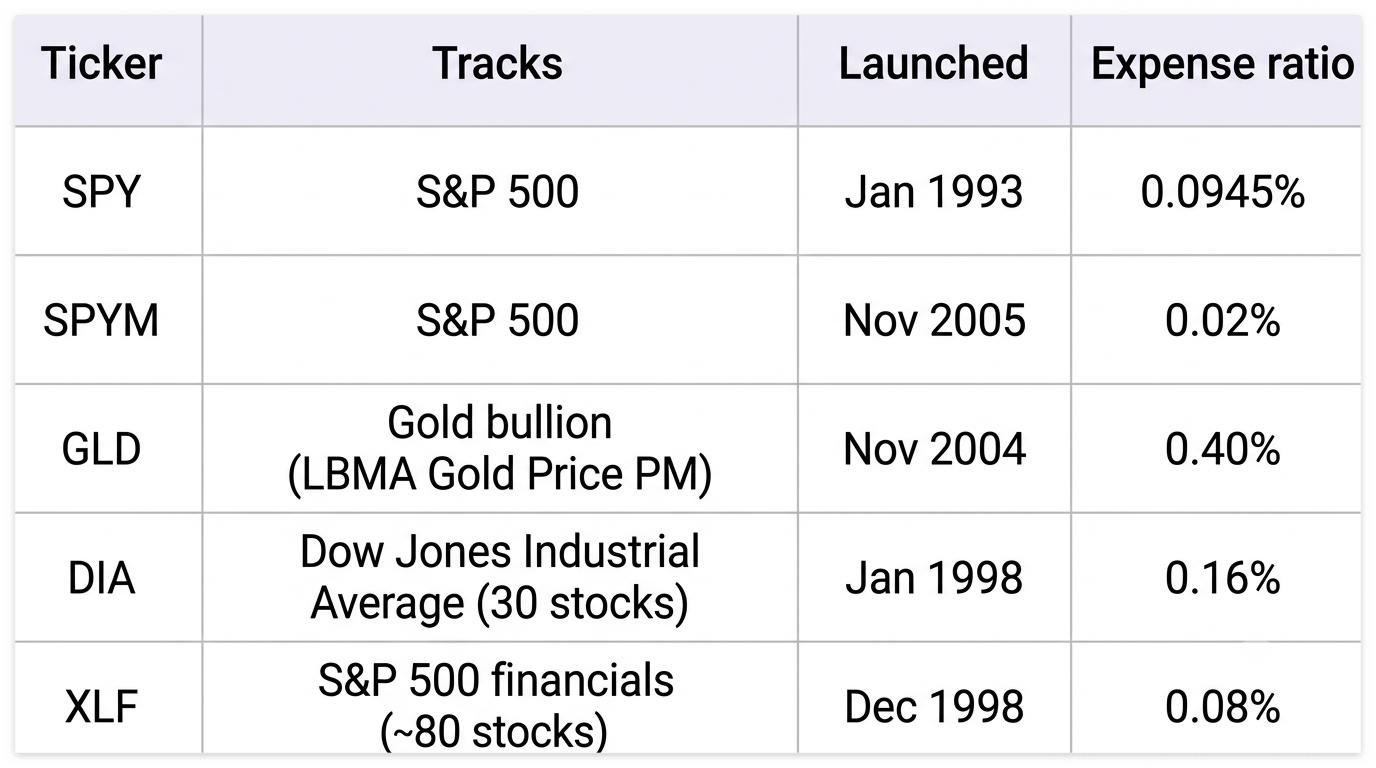
SPY vs. SPYM vs. VOO vs. IVV: same index, different structure
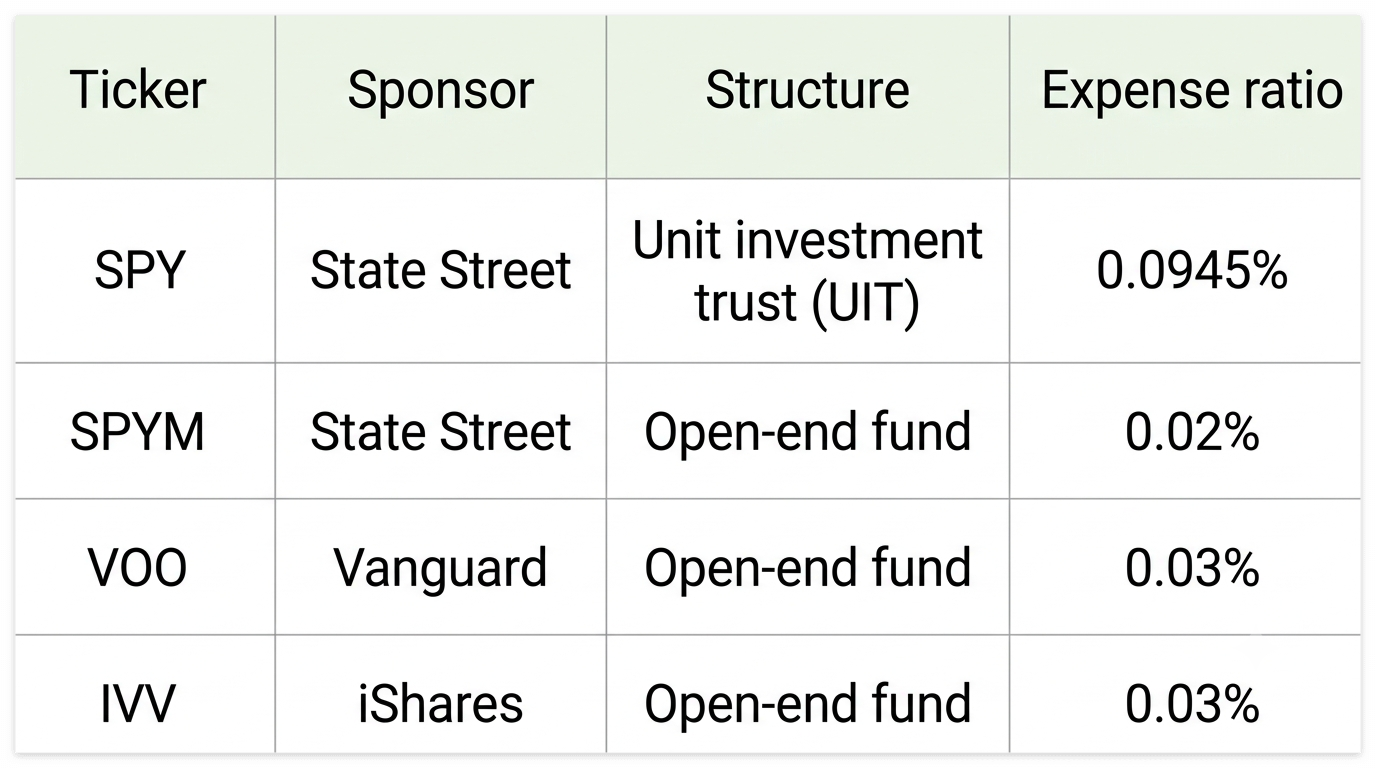
The holdings are nearly identical. The structure and fee are not. SPY is a 1993-era UIT, and analysts commonly note that this format can't reinvest dividends between quarterly payouts or lend out securities for extra income. The open-end funds can do both.
The fee gap between SPY and SPYM is 0.0745 percentage points, or $74.50 a year per $100,000. That is small in any single year, but it compounds for buy-and-hold investors.
Does that make SPY obsolete? No. It is widely described as having the deepest options market of any ETF, and State Street cites average daily trading of about $52.6 billion. Active traders and options users get real value from that depth.
SPYM also has a longer history than its ticker suggests. It launched in 2005 as ONEK, tracking the Russell 1000. It became SPLG in November 2017, switched to the S&P 500 in January 2020, and took the SPYM ticker on October 31, 2025. Anyone who held SPLG still holds the same fund. It trades less than SPY, so frequent traders should check the bid-ask spread first.
GLD, DIA, and XLF: what each one really is
GLD holds physical gold bars and pays no dividends. It isn't a stock fund, so it doesn't compete with SPY. It plays a different role in a portfolio. World Gold Trust Services sponsors it, with State Street as marketing agent. The 0.40% fee is higher than most rival gold ETFs, and its price ranged from about $340 to $510 over the past 52 weeks. In US taxable accounts, data providers list GLD under collectibles tax treatment (a 28% maximum long-term rate), so confirm the details with a tax professional.
DIA is also a UIT. It holds 30 stocks and weights them by share price, not market value, so high-priced names such as Goldman Sachs and Caterpillar carry extra weight. Thirty stocks sounds less diversified than 500, but market-cap weighting concentrates SPY too. As of July 2026, Nvidia, Apple, and Microsoft made up about 19% of SPY together.
XLF covers the financial sector of the S&P 500. It's not just a bank fund. Its top five holdings are Berkshire Hathaway, JPMorgan, Visa, Mastercard, and Bank of America, together about 41% of assets (ETF Database, subject to change). Financials also make up roughly 27-29% of DIA and are already part of SPY, so owning several of these means overlapping bets.
How to choose
- Index and weighting: Check what the fund tracks and whether it weights by market cap or price.
- Cost and structure: Compare the expense ratio and whether it's a UIT or an open-end fund.
- Trading depth: Average volume and bid-ask spread matter most for frequent trades and large orders.
- Overlap: Check how much of a new fund you already own through SPY, DIA, or sector funds.
- Fit: Match the fund to its role and your time horizon. Sector and commodity funds swing more than broad ones, and any ETF can lose money.
- Taxes and fees: Account type, brokerage fees, and currency costs vary and are easy to overlook.
New investors often ask me which issuer is "best." My read is that iShares offers the widest range of asset classes, Vanguard leans toward low costs and long holding periods, and State Street stands for the history of the ETF itself. That is an impression, though. The checklist above will tell you more than any brand.
Most's original pitch was to trade a basket of stocks like a single stock. More than 30 years later, the fee on the same index has fallen from 0.20% to 0.02% or less, so the question now is which wrapper suits the job.
This article explains ETF history and structure for educational purposes and is not a recommendation to buy or sell any security. Fees, asset levels, and holdings change often (data here is from September 2026), so verify current details with the fund provider before investing. Investment decisions and their outcomes are your own responsibility.
Sources: State Street Investment Management fund pages (SPY, SPYM, GLD, DIA, XLF); State Street's SEC filing "SPY: The Idea That Spawned an Industry"; Bloomberg (2016); InvestmentNews (2016); World Gold Trust Services (GLD); ETF Database; Yahoo Finance; 24/7 Wall St. (2026 holdings data).


