Gold, oil, copper and wheat all trade in the commodity markets, but you can reach them in very different ways. You can hold bars in a vault, buy an ETF in your brokerage account, or trade futures contracts directly. Each route has its own costs, tax rules and worst-case outcome.
This guide covers what moves each major commodity group, the main ways to get exposure, and how futures margin and trading hours work. It ends with questions to help you choose. The tax examples are U.S.-based. Rules differ in other countries, so check your own.
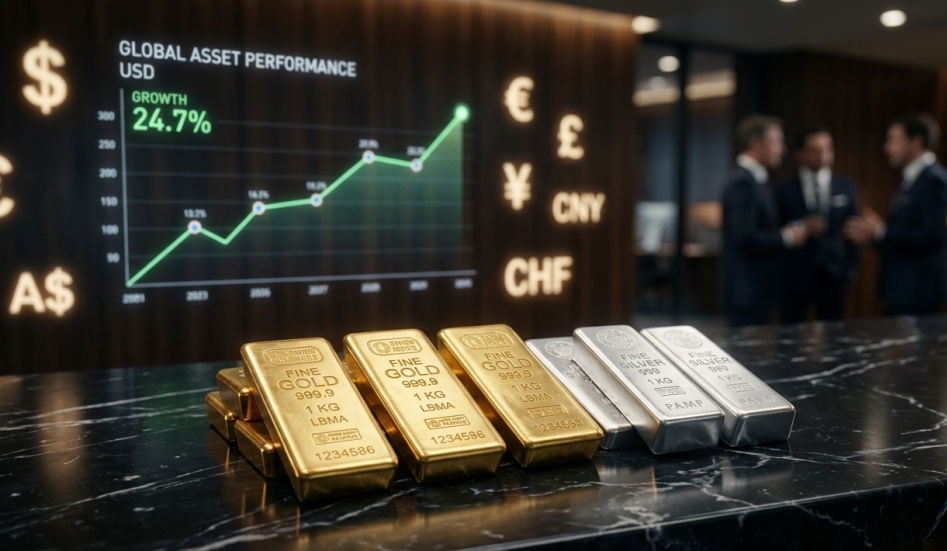
The four commodity groups and what moves them
Commodities fall into four broad groups, and each responds to a different set of forces. Knowing which force matters helps you decide which news to follow.

Gold and copper get lumped together, but they behave differently. Gold pays no interest, so rising interest rates tend to make it less attractive, while market stress tends to increase demand. Copper goes into buildings, wiring and vehicles, so its price often tracks the health of the manufacturing economy. Traders sometimes call it "Dr. Copper" for that reason.
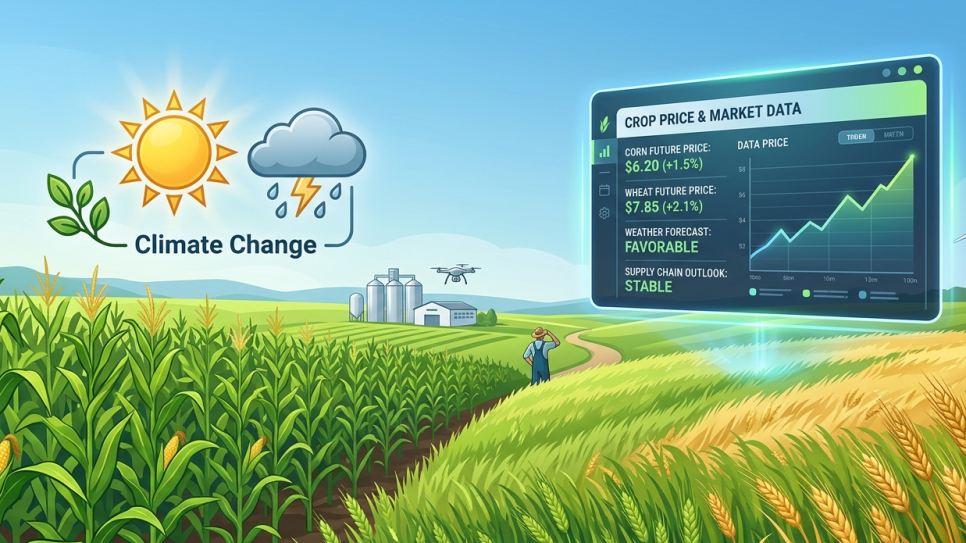
Grains are the hardest group to model. A dry spell in the U.S. Midwest can move prices more than any economic report.
One caution about diversification. Commodities often rise when inflation surprises to the upside, but the link is not reliable in every period. In a sharp recession, oil and copper can fall right alongside stocks.
Five ways to invest in commodities
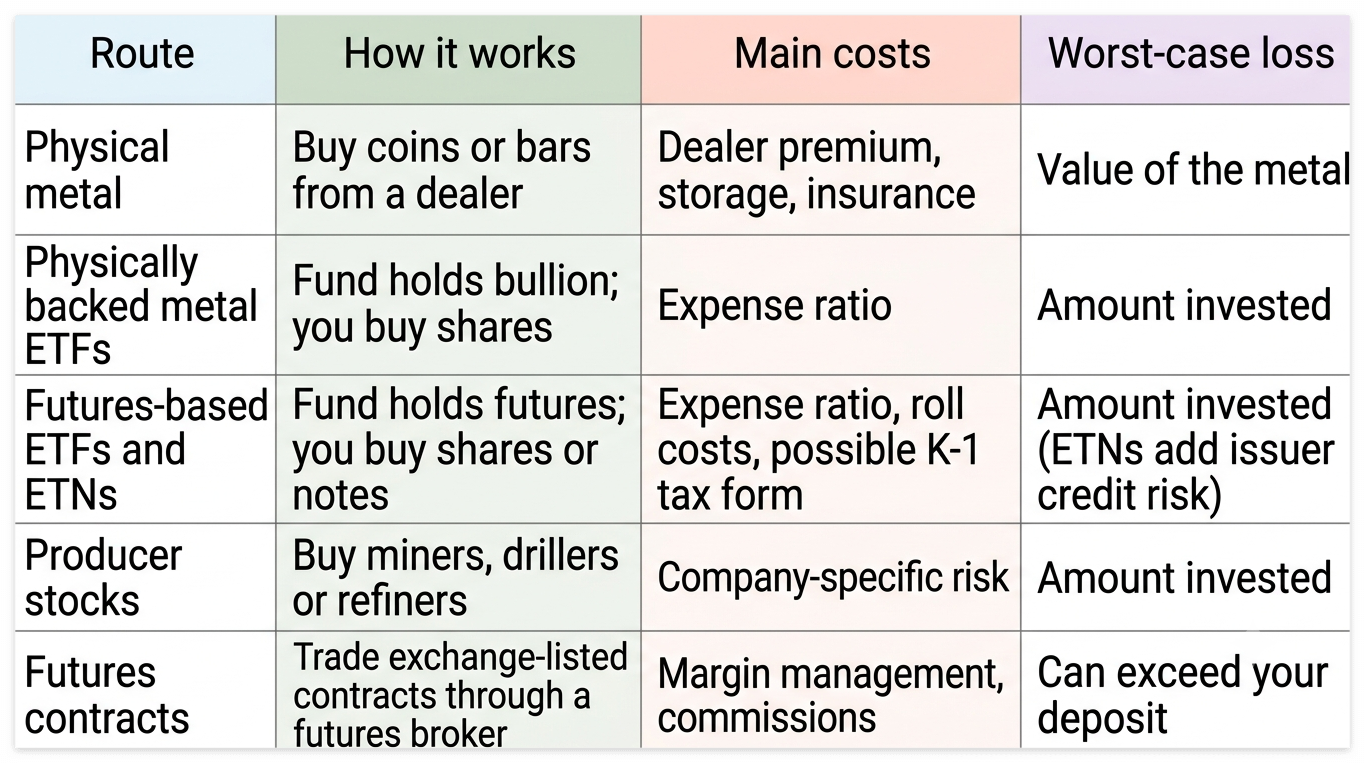
Some of these routes have tax quirks that surprise people. In the U.S., accountants say the IRS treats ETFs backed by physical gold and silver as collectibles. Long-term gains face a top federal rate of 28%, compared with 20% for most stocks. Many oil and grain ETFs are structured as commodity pools, which typically send investors a Schedule K-1 instead of the usual 1099. Exchange-traded notes avoid the K-1, but they are debt from the issuing bank, so you take on that bank's credit risk.
Producer stocks are the simplest option tax-wise. They are ordinary shares. They also mix in company risk such as management, debt and costs, so they will not track the commodity price one-for-one.
Why a futures-based ETF can lag the commodity
Most oil, natural gas and grain ETFs hold futures, not barrels or bushels. As a contract nears expiry, the fund sells it and buys the next one. This is called rolling.
If later-dated contracts cost more than the near one (a market shape called contango), each roll costs the fund money. Here is an illustration with made-up numbers. The fund sells an expiring contract at $70 and buys the next one at $71. If prices then stay flat, the fund has lost roughly 1.4% on that roll, and the loss repeats every month.
So a futures ETF can trail the commodity's price over long holding periods, even when the commodity itself goes nowhere. It is a better fit for short-term views than for buy-and-hold.
Leveraged and inverse ETFs add another wrinkle. They reset daily, so over long periods their results can drift away from a simple multiple of the commodity's move.
Trading futures directly: what you need to know
Contract size and per-dollar moves
A standard WTI crude contract (CL) covers 1,000 barrels. A $1 move in the crude price changes the value of one contract by $1,000. Try a quick mental example: at $70 a barrel, one contract controls $70,000 of oil, even though you post only a fraction of that as margin.
Exchanges list smaller versions, and CME Group's Micro contracts are one-tenth the size of the standard ones.
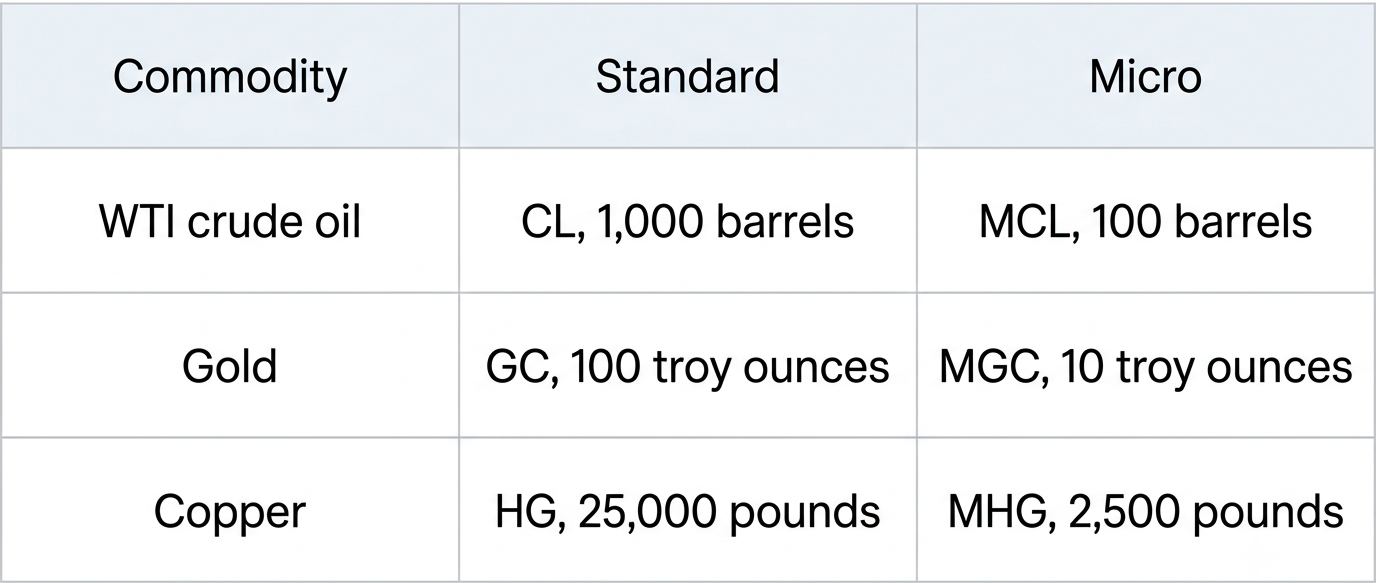
Micro WTI is also settled in cash, while standard WTI is settled by physical delivery, according to CME Group. Retail traders generally close standard contracts before expiry, and brokers set their own cutoff dates.
Margin and forced liquidation
Futures margin is a good-faith deposit, not a down payment. You post initial margin to open a position and must keep your account above the maintenance margin level. Profits and losses are settled against your account every day. If your balance falls too low, your broker can close positions to cover the shortfall, often without waiting for you to respond.
Exchanges and brokers change margin requirements as volatility shifts, so check current figures on CME Group's website and with your broker before trading.
Trading hours
Energy and metals futures on CME Globex trade from 6:00 p.m. Sunday to 5:00 p.m. Friday (Eastern Time), with a one-hour break each day beginning at 5:00 p.m. That gives you about 23 hours of trading per weekday. Grains follow a different schedule, roughly 7:00 p.m. to 7:45 a.m. and 8:30 a.m. to 1:20 p.m. Central Time. Confirm session times and holiday closures on CME's calendar.
Losses can exceed what you put in
On April 20, 2020, the May WTI crude futures contract settled below zero, at roughly negative $37 a barrel. Traders holding long positions into expiry lost more than the price they had paid. The episode is the clearest demonstration that a futures position can lose more than the cash you deposited.
How to choose a route
Start with three questions.
- How long do you plan to hold?
- Must your loss stay within the amount you invest?
- Can you monitor a position throughout the trading day?
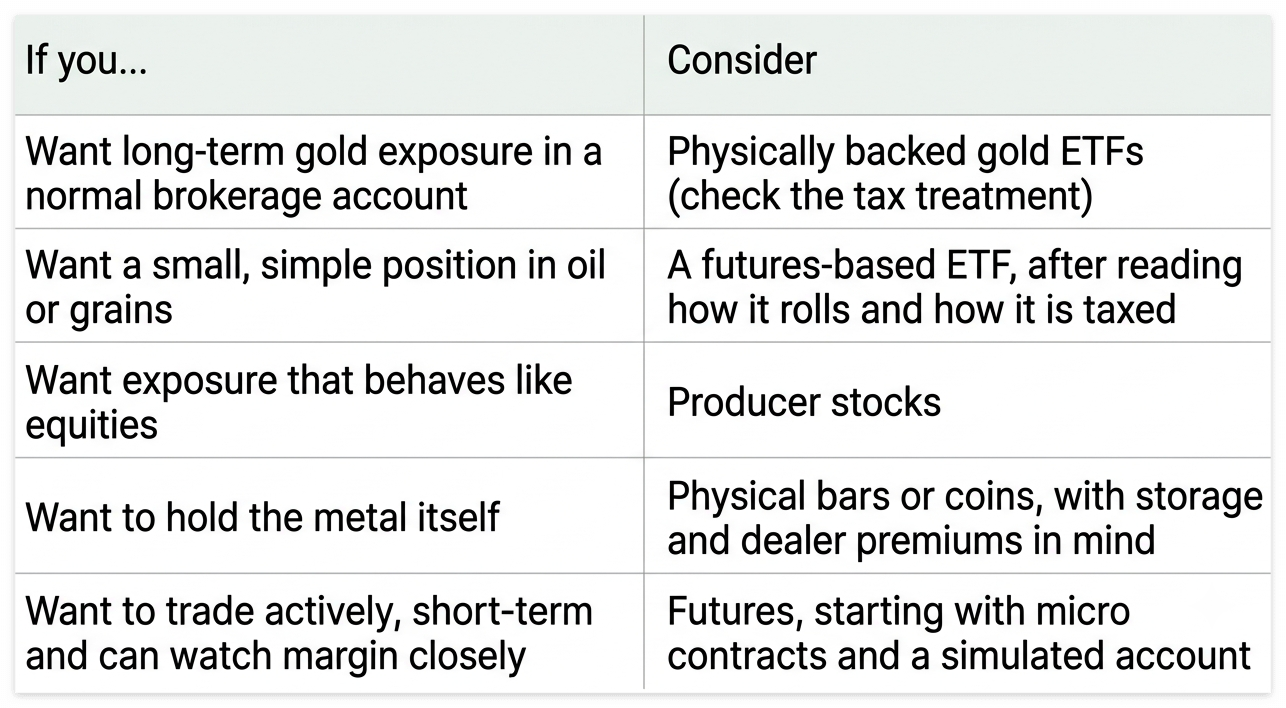
The gap between the second and last rows is the one that trips up new investors. An ETF's loss stops at what you invested, while a futures position keeps running until you close it or your broker does.

A short checklist before you start
- Know whether the product holds the physical commodity, futures or company shares.
- Read the fund's prospectus for its roll method, fees and tax form.
- Confirm your account type. Some retirement accounts limit which commodity products you can hold.
- For futures, decide in advance how much you can lose and what happens at expiry.
- Practice with a simulated account first, remembering that simulated fills can differ from real ones.
This article is for education, not personal financial or tax advice. Fees, margin and tax rules change, so verify current details with your broker, the exchange and a tax professional.
Sources: CME Group, "Micro WTI Crude Oil Futures FAQ" (cmegroup.com); CNBC, "Gold, silver ETF owners face 28% top tax rate on profits" (cnbc.com, March 14, 2022); ETF.com, "K-1 Taxes Hurdle For Commodity ETFs" (etf.com).


