Have you ever felt the urge to buy a stock because everyone else seemed to be making money from it? Or wondered whether skipping a popular event meant you were missing out on something important?
These feelings are often described by two modern psychology concepts: FOMO and JOMO. While they began as cultural trends linked to social media and digital life, they now play a major role in how people spend money, invest, manage relationships, and make daily decisions.
In this guide, we'll explore what FOMO and JOMO mean, why they matter, and how understanding both can help you make better financial and personal choices.

FOMO vs. JOMO at a Glance
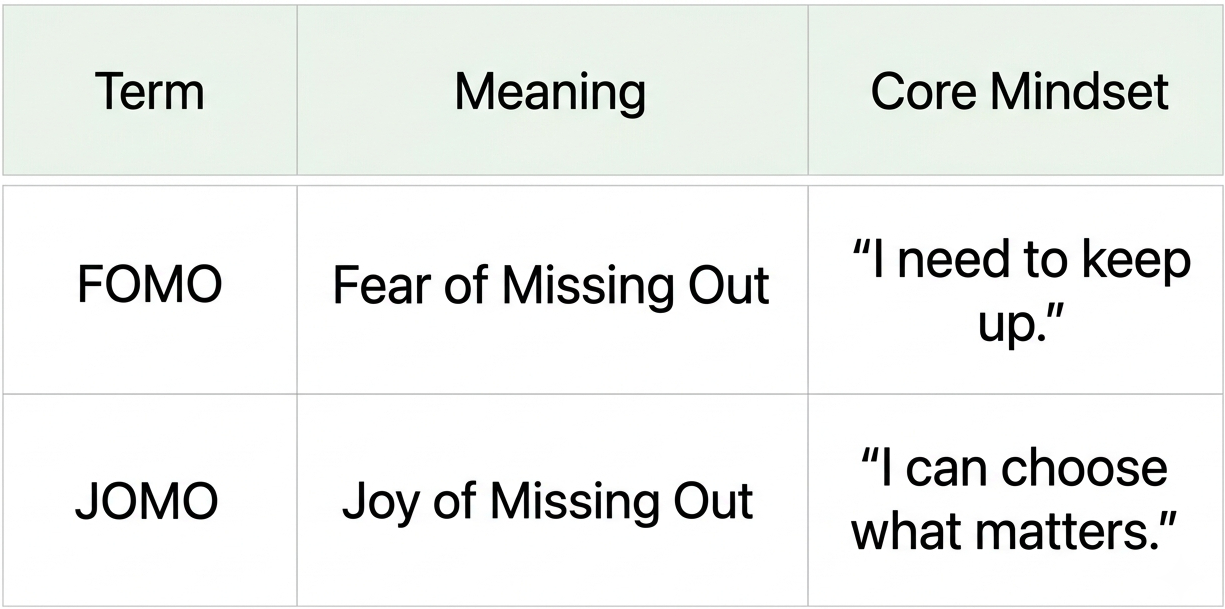
Although the two concepts sit at opposite ends of the spectrum, both reflect how people respond to opportunities, information, and social comparison.
What Is FOMO?
FOMO (Fear of Missing Out) refers to anxiety that others are experiencing opportunities, rewards, or success while you are being left behind.
The term became widely known in the early 2000s and gained momentum alongside social media platforms that made other people's experiences visible around the clock.
FOMO often appears in situations such as:
- Seeing friends post vacation photos online
- Watching a stock price soar after ignoring it for months
- Feeling pressure to join every social event
- Buying products simply because they are trending
At its core, FOMO is less about the opportunity itself and more about the fear of being excluded from it.
Common Signs of FOMO

What Is JOMO?
JOMO (Joy of Missing Out) is the opposite mindset.
Rather than feeling anxious about opportunities you didn't pursue, JOMO involves accepting that you cannot do everything and focusing on what genuinely adds value to your life.
People who embrace JOMO are not disengaged from the world. Instead, they make deliberate choices about where to invest their time, energy, and attention.
Examples include:
- Spending a quiet evening at home instead of attending every event
- Limiting social media use
- Ignoring investment trends that do not fit a personal strategy
- Prioritizing meaningful relationships over large social networks
In recent years, JOMO has become closely associated with digital wellness, mindfulness, and healthier technology habits.
Why Do People Experience FOMO More Than Ever?
Modern technology has dramatically increased the amount of information competing for our attention.
In previous generations, people mainly compared themselves with family members, neighbors, or coworkers. Today, smartphones expose us to thousands of curated success stories every day.
A key problem is that online content often highlights achievements while hiding setbacks.
You may see:
- Investment gains
- New business successes
- Luxury purchases
- Travel experiences
But you rarely see:
- Investment losses
- Debt burdens
- Failed projects
- Personal struggles
As a result, people can develop a distorted perception that everyone else is succeeding all the time, which fuels FOMO-driven decisions.
The Psychological Difference Between FOMO and JOMO
The most important distinction lies in where attention is directed.
FOMO focuses outward.
Questions tend to sound like:
- What is everyone else doing?
- Which opportunity am I missing?
- How can I keep up?
JOMO focuses inward.
- Questions tend to sound like:
What matters most to me? - Does this fit my goals?
- Is this worth my time and attention?
The difference may seem subtle, but it often leads to completely different decisions.

How FOMO Shows Up in Investing
Financial markets are a natural environment for FOMO.
When prices rise rapidly, investors often experience emotional pressure to act before it is "too late."
Common examples include:
- Buying a stock after a large rally
- Following social media investment influencers without conducting research
- Investing based on fear rather than analysis
- Taking excessive risk to avoid being left behind
Why FOMO Investing Can Be Dangerous
One useful question to ask before investing is:
Would I still buy this asset if nobody were talking about it?
If the answer is no, the decision may be driven by FOMO rather than sound analysis.
Cryptocurrency and Market Hype: A Common Example
Cryptocurrency markets have repeatedly demonstrated the power of FOMO.
During major bull markets, many investors entered after hearing stories of extraordinary gains. Media coverage, social media discussions, and rapid price appreciation created a perception that missing the trend would be costly.
The challenge is that rising prices often attract attention precisely when risk is increasing.
A lesson that applies to any asset class:
Past gains do not guarantee future returns, and popularity is not the same as value.
What Does JOMO Investing Look Like?
In investing, JOMO is not about avoiding opportunities altogether.
Instead, it means being comfortable passing on opportunities that do not fit your strategy.
JOMO-oriented investors typically:
- Follow predefined investment criteria
- Avoid assets they do not understand
- Accept that they cannot capture every market rally
- Focus on long-term outcomes rather than short-term excitement
This approach may appear slow during speculative booms, but it often helps investors avoid costly emotional decisions.
Lessons From Warren Buffett's Investment Philosophy
One of the most frequently cited examples of disciplined investing is Warren Buffett's emphasis on staying within a "circle of competence."
During the late-1990s dot-com boom, many investors rushed into technology stocks based on future expectations rather than established business results.
Buffett was criticized for avoiding many of these companies because they fell outside areas he felt comfortable evaluating.
While the experience does not prove that every popular investment is a mistake, it illustrates an important principle:
Successful investing often involves knowing which opportunities to ignore.

Practical Ways to Reduce FOMO
1. Create Written Investment Rules
Before investing, define criteria such as:
- Do I understand the business?
- Does it fit my risk tolerance?
- Am I investing for the long term?
- Would I make the same decision without outside influence?
Written rules create a buffer between emotion and action.
2. Limit Social Comparison
Consuming financial content constantly can distort judgment.
Staying informed is valuable. Obsessively tracking what other people are doing often is not.
3. Think of Cash as Optionality
Many investors feel uncomfortable holding cash when markets are rising.
However, cash can provide flexibility when attractive opportunities emerge in the future.
4. Pause Before Acting
A simple 24-hour waiting period before major financial decisions can help separate genuine conviction from fear-driven reactions.
Applying JOMO Beyond Investing
The principles behind JOMO extend well beyond financial markets.
Spending
Instead of buying based on trends, focus on usefulness and long-term value.
Productivity
Rather than participating in every opportunity, concentrate on activities that align with specific goals.
Relationships
Quality relationships often provide greater satisfaction than attempting to maintain countless connections.
Digital Life
Reducing notifications and limiting unnecessary screen time can create more mental space and reduce comparison-driven stress.
Frequently Asked Questions
Is FOMO always a bad thing?
No. FOMO can encourage curiosity and help people discover new opportunities. Problems arise when anxiety replaces thoughtful decision-making.
Does JOMO mean rejecting social interaction?
Not at all. JOMO is about intentional choice, not isolation. It encourages focusing on experiences and relationships that genuinely matter.
Which mindset is better for long-term investing?
Many long-term investors benefit from a JOMO-oriented approach because it promotes discipline, patience, and adherence to a strategy.
How can I tell if I am making a FOMO-driven decision?
Ask yourself whether you would make the same choice if nobody else were discussing the opportunity. If social pressure is the primary motivation, FOMO may be influencing your judgment.
Final Thoughts
FOMO and JOMO are more than internet buzzwords. They reflect two fundamentally different ways of responding to opportunities and uncertainty.
FOMO is driven by comparison and the fear of being left behind. JOMO is rooted in selective attention and confidence in personal priorities.
Whether you're investing in stocks, managing your finances, or deciding how to spend your time, the most valuable skill may not be spotting every opportunity. It may be knowing which opportunities deserve your attention and which can safely be ignored.
In a world that constantly tells you to do more, buy more, and keep up with everyone else, JOMO offers a simple alternative: focus on what matters most and let the rest go.


